
A Writing Chance?
Tackling the marginalisation of working class writers - by Clare

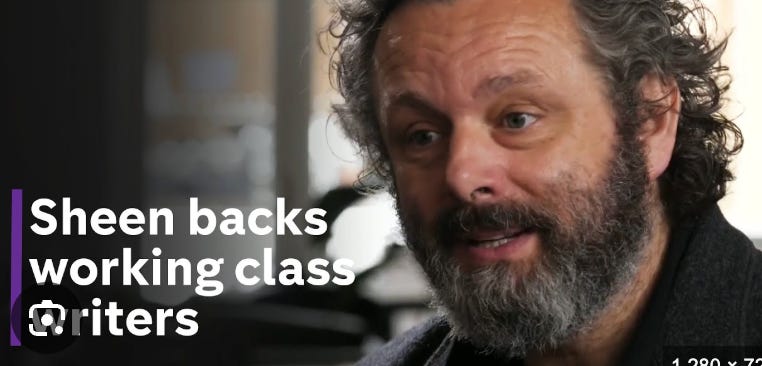
I blummin’ love Michael Sheen – especially since he took to national media to point out that “Today, half of published authors have middle-class backgrounds – but just 10 per cent are working-class” (Daily Mirror 2025). Put simply, the under-representation of working-class people in writing is getting worse.
I thought I knew what class was before I went on my first Arvon residential. I thought the middle class was nurses and teachers – not the company directors and consultants I was about to spend the week with. I’d never met anyone born into money, let alone eaten sausages with them. It was an education in privilege which continues to this day – at a recent literary event, three of the people at my table had been to the same famous public school.

My Burnley school may have produced other writers, but I haven’t met or heard of them. And as Michael says, “We know that kids from all walks of life enjoy reading at school, and working-class people are some of the best storytellers out there, so somewhere, somehow, something’s going wrong.” When writing excludes whole swathes of the population, we all lose out. So in 2021, Michael teamed up with New Writing North and Northumbria University to launch ‘A Writing Chance’ – a programme of support for writers from working-class and under-represented backgrounds.
In a report based on the first year of the programme, Dr Kate Shaw (2021) found that a London-centric writing industry, plus a lack of networks, were amongst the multiple obstacles faced by working class writers. There’s also:
- knowledge and permission: “I don’t know where you get in, or how you get in, or once you get in what’s on the other side of the in. If there is a door to go through, I don’t know where the door is, or how to get to it, and if I do find it, I haven’t got a key.”
- the financial precarity of writing: “This is not a sustainable career for emerging working-class people, especially those with families, dependents, or caring responsibilities.” (Becka White);
- age, health, disability and intersectionality
- and a lack of confidence: “Imposter Syndrome clings to me like a bloody limpet to a rock.” (Stephen Tuffin).
I was lucky. My mum taught us to always act as though we belonged. Posh people don’t look fancy, they just look entitled, she told us. Aristocrats wear old clothes; they have cold houses too. And I flippin’ loved that first Arvon course. I attended for free – a 100% bursary – and it opened doors for me I didn’t even know existed. After my third heavily subsidised course, I kept in touch with some of the other participants and we arranged to meet up in London. I stayed with a lovely chap who took me for a drive down The Mall in his open top car. We visited the summer show at the Royal Academy, and had tea at the Groucho Club. Tracey Emin was there, and I didn’t have the faintest idea of what to do when the waiter offered me basket of bread rolls. And despite what Mum taught me, I panicked – was I meant to point at the one I wanted, or pick it up?
If you don’t belong in a culture, then you don’t know its unspoken rules and expectations, its terminology and etiquette, its shared histories. There’s an ever-present tension, a sense of not fitting in. You might never hear your own accent, or see the colour of your own skin. Your concerns or priorities may never be acknowledged or shared, perhaps no one will know the pain or the cost or the risk you may have faced just to be in the room. Don’t laugh too loudly, don’t clap or cheer in the wrong places, do not fidget. You may feel unwelcome, or judged, and never be able to work out why. You may find yourself exoticised, playing a role you never chose. Gatekeeping and exclusion works in a myriad of ways – some conscious and overt, others nuanced and complex.
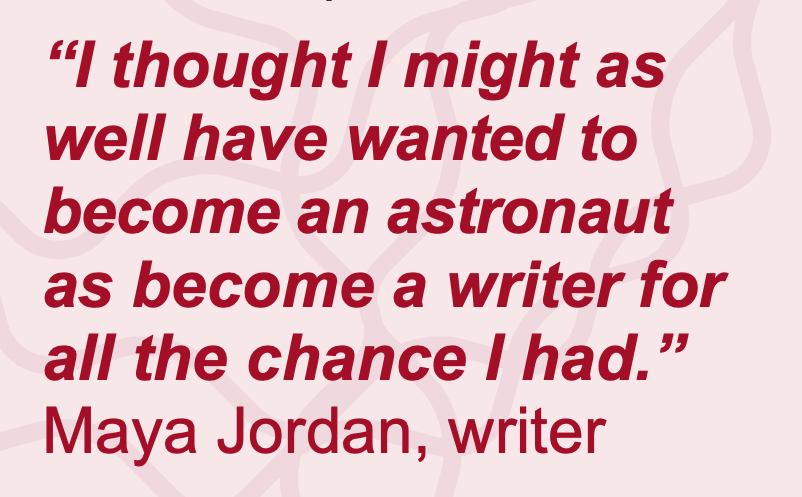
In response, The Writing Chance report made a series of recommendations. Under-represented writers, it said, should be supported with “an identifiable network which would support them with information, highlight opportunities, and build confidence” – and this process should be supported by mentors. Publishers and media groups in particular should “make mentoring opportunities available to a targeted number of people from working-class backgrounds each year”. Writing organisations should monitor class backgrounds in their workforce and recruitment data, and should collaborate with each other to address the underrepresentation of working-class people.
For nearly two decades now, I have taught rather than attended Arvon courses. Like most freelance writers, my career is made up of a mixture of writing jobs: from school sessions to workplace writing, from poetry workshops to individual mentoring. As a poetry mentor, I help people to develop their writing, edit their work, find a platform for their work, and along the way, to negotiate some of the most challenging aspects of the writing industry – like rejection, lack of self-confidence, or the emotional labour of writing difficult material. In 2024, I was invited to be a pastoral mentor for some of that year’s Writing Chance students. But this time, the mentoring role was different.
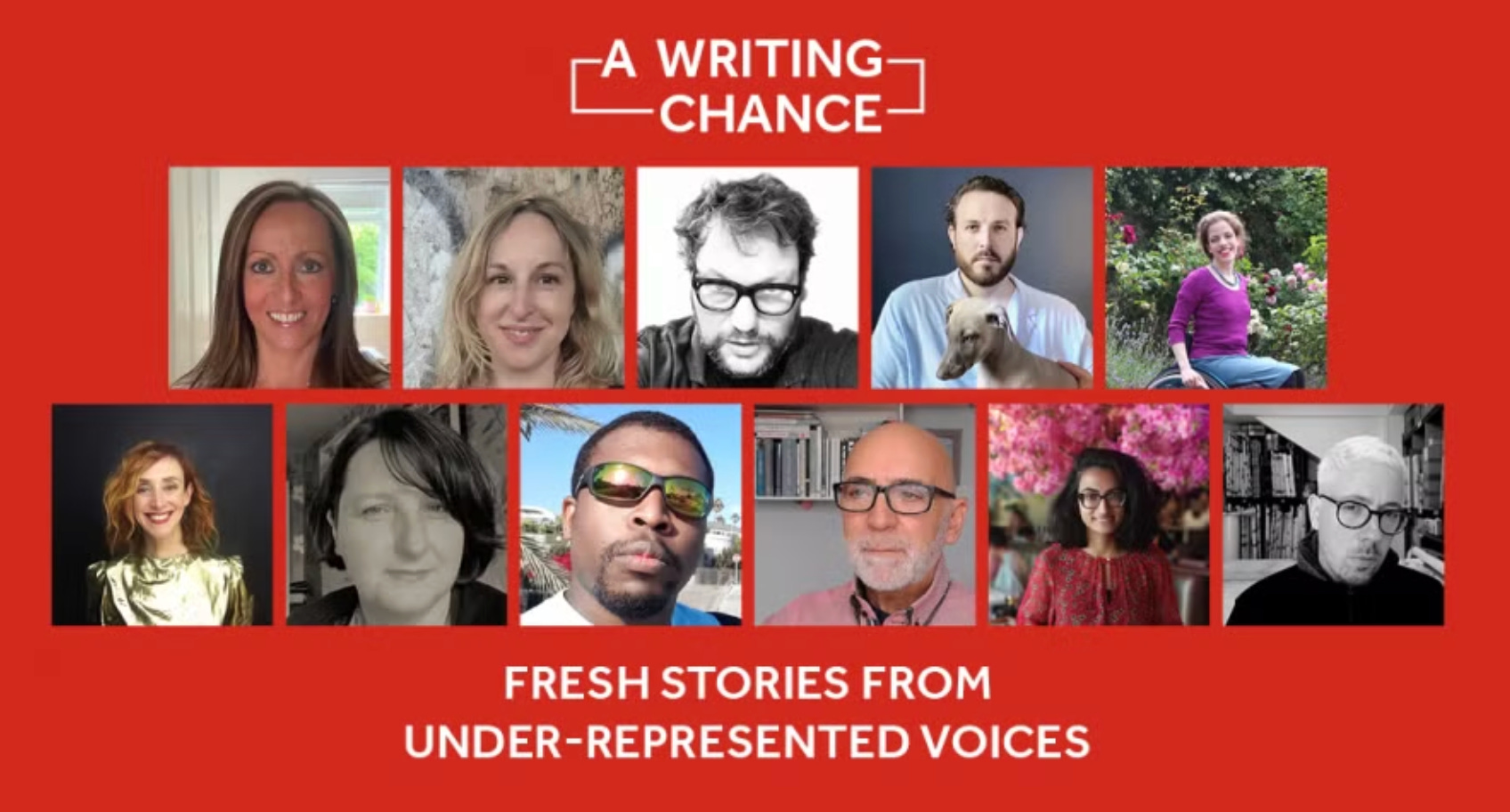
In addition to our regular meetings, the students also had an industry mentor from either the Daily Mirror, Substack, or Faber and Faber – along with a £2,000 bursary, and a five-day residential Arvon retreat. New Writing North co-ordinated the programme, and offered other forms of ongoing support through the year – including workshops, meetings and online resources – with the aim of helping those writers to develop networks, skills and confidence. Brilliant. But my first question was probably the same as yours – what is a pastoral mentor? What on earth do I do?
Well, firstly, I wasn’t there to read anyone’s work, or to suggest wider reading or routes to publication. However talented, a writer has to do so much more than read and write to be successful in the writing industry. Writing demands a level of self-belief, resilience and self-care. A freelance writer needs all the skills of a small business owner – marketing, admin, publicity and so much more – let alone the motivation, self-discipline, and confidence. A writer needs a room of their own, time to write, money to live on. And a writer from a marginalised, disadvantaged or under-represented community needs even more – the validation we have been deprived of, access to networks, help with negotiating unspoken rules and conventions, the information and practical resources which may help us to take our first steps up a mountainous playing field. Over the course of eight sessions, this was my job, along with checking in with mentorees about their experience of the programme.

The experience asked me to draw from, and to step outside of, my own experiences. It gave me a broader, deeper, more sustained understanding of the challenges faced by aspiring writers – how those challenges reflect imbalances in society – and how they might be addressed at an individual and organisational level. Sometimes, it was enough to be a warm, supportive voice, to remind mentorees about the importance of self-care, or to help them create a writing plan. At other times, when mentorees faced difficult life events, I turned to New Writing North for additional resources. But when it came to the major structural inequalities each student faced, I knew that the support I offered was a drop in the ocean.
But an ocean is made of drops. There is a real dedication within this programme to creating change. I loved being able to work directly and openly with some of the obstacles which stand in the way of our writing – poverty, disability, poor housing, low confidence, exhaustion – whilst sharing in the creativity and excitement, the hope.
And it’s hope I was left with. I worked with four really wonderful young writers. They were brimming with talent, intelligence and creativity, and they reminded me of everything I love about writing. And though not everyone ended the year with a book deal, to some extent they all achieved their goals – creating a writing routine which incorporated self-care and a sustainable workload. Feeling themselves part of a community of writers. And along the way, they learned that whatever ambitions and intentions we have, life has a way of sending us in new directions, and sometimes, that’s where we’ll find the buried gold.
And for me? Whilst the programme validated my belief in warmth, humility, and connection as our best tools in teaching, its greatest impact on my practice was renewing my faith. New Writing North state “we can change who gets to write” – and the programme showed me we can, we should, and we do. NWN and Michael Sheen don’t want to turn the world of writing upside down: they just want to open it up. They want talented working-class writers, and other marginalised writers, to have a writing chance. It’s the very least we should aim for. Count me in.
I used to work in a north west sixth form college. One year six of my students were in the Young Foyles top 100. They were invited to the London celebration. I had to explain though they would have loved to go they couldnt afford either a train fare, the hire of a mini bus or an overnight stay - ideas all suggested by the Poetry Society. On understanding this The Poetry Society did something truly powerful for the students. They came up north, printed a separate booklet with the six students poems in and ran their own celebration for them! It made such a difference to the way they felt about their writing and its importance
Thank you so much Clare for this brilliant article and for bringing awareness to it. The struggle is very, very real. It is exhausting and demeaning and often feels like an uphill battle. Sometimes it seems as though every single door is closed and writing is the very last thing I am inspired to do. The competition is rife and those who do need the step up or the help are often overlooked or slip through the cracks. Being unemployed and from a low income background and area the choices are severely limited every which way and it’s very easy to give up on the dream and just fall back into old patterns. Breaking out of what is expected of us or breaking through the glass ceiling at times feels nigh on impossible. Thank you from the bottom of my heart to both yourself and Kim who always, always provide the option of bursary places or reduced ticket prices. So often for people from low income backgrounds choices have to be made, sacrifices made and opportunities missed out on. It feels very much like standing outside of a window and watching the writing world pass by on the other side