
August Reading
By Kim Moore


August is usually when I attempt (and fail) at the Sealey Challenge. You can find information on the Sealey challenge here. Set up by the poet Nicole Sealey, she writes that “The goals are simple: read a book each day, engage with diverse voices, and be an active member of an online community of poetry lovers.” I love the idea of this and every other year have set off with excellent intentions and then failed abysmally. This year I am less delusional and more realistic about what I can imagine. Still, I am absolutely determined to read some of the poetry books that have been sitting on my to-be-read shelf for a while during August. I haven’t managed one every day but it’s been great this month to focus on poetry a little more closely than previous months.
Lillith Speaks
By Clare Proctor
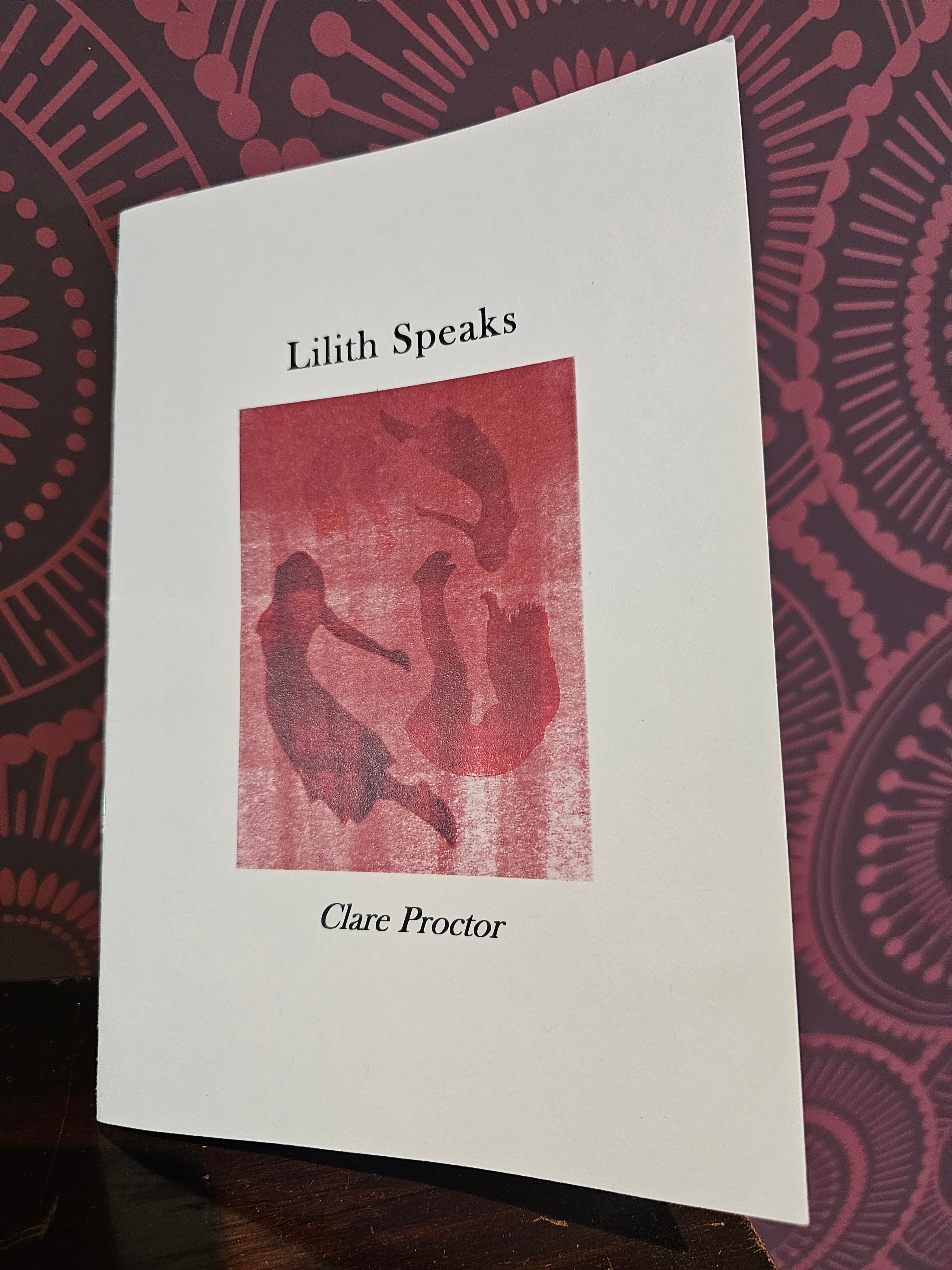
Clare is a poet based in Cumbria who I think I first met at a poetry group, or at an event. Later I was lucky enough to mentor her as part of some of the work that Lancaster LitFest does. Clare is a fabulous poet whose work I really believe in - when I did a guest editorship of The Poetry Review alongside Hannah Lowe, I was very happy to find Clare’s poems in the inbox, and we published “On Absence” - a wonderful prose poem which unpacks the word ‘absence’ with an unrelenting focus, moving from the calling of a register in a classroom, to directly addressing the reader and asking us how we conceive of absence, to the absence that infertility creates.
So many of the poems in this pamphlet stay with me. There is the delicious wit and sly humour of the title poem “Lillith Speaks”, where Clare is drawing from a 15th century witch hunting manual written by Heinrich Kramer, who claimed that witches collect penises and keep them in a box (because if I was a witch, that’s totally what I would spend my time doing!). I love the physicality in this one. It begins “We keep them as pets”. The witches, in this poem at least are fond of the penises. They ‘snuffle / through oats”. They are “Brainless, they wriggle in the basket” and the witches hold their ‘favourites /feel them fattening /between our hands”. These witches know the penises better than the men they belong to because the poem finishes “You want yours back / but you never make the right choice, / you never claim your own.”
Many of these poems remind me of the John Berger quote: “Men look at women. Women watch themselves being looked at”. This is really apparent in another of my favourites, “Sappho’s Leap”, which won second prize in the Ware Poetry Competition. In this prose poem, anger and sarcasm and irony push against each other. Clare writes:
“If the women want to jump from cliffs, they should dive in a perfect arc.” Even in desperation, women should be beautiful, should be aware of how they look. And later “They should avoid ugly crying, or they may not be a fitting subject for a painting”.
There is a beautiful (and tonally very different) ghazal called “Evening, garden” which begins:
"The garden has stretched her limbs wide, tonight
and thoughts of my mother preside, tonight"
and a wonderful poem called “Animal Instinct” where the speaker is trying to get pregnant, and imagines that her eggs “detach themselves with attention (a tearing / of cell from cell, / a setting off for a date not made - tick / tock, as if they wore heels, /clicking down a passageway /towards the light.”
Clare was one of three winners of the Lancaster Litfest pamphlet competition, alongside Rebecca Bilkau and Maria Isakova Bennett, and all were published by Wayleave Press. Wayleave is a fantastic (and tiny) independent press run by the brilliant poet Mike Barlow. Wayleave Press publish beautiful pamphlets, all by poets based in Cumbria or Lancaster (I think). You can buy Clare’s pamphlet here for the princely sum of £7, or all three pamphlets at the same website for £18.
I am really looking forward to seeing what Clare does next, and hope a publisher snaps up her first full-length collection soon.
Poetry London
Summer 2025 issue

I loved this issue of Poetry London to the point where I started to wonder if I have exactly the same taste as the editor Niall Campbell. There are two new poems by Carl Philips to start the issue off which I really enjoyed, featuring Philips trademark winding, restless use of syntax and long sentences in the second poem in particular. I also loved the ‘Sestina for Elizabeth Bishop’ by Clare Pollard which has made me look forward to her forthcoming Bloodaxe collection even more, and a new poem Mona Arshi which made me want to order her new collection ‘Mouth’ straight away (sadly need to wait until I get paid!). There’s a brilliant poem by Padraig Regan ‘The Leafy Sea Dragon’ which is a close and meticulous observation of the sea dragon, where we learn all kinds of interesting things about this creature I hadn’t heard of in scientific and lyrical details. We are told that he ‘fibrillates his cellophane /neck-fins' and later that ‘He is his own autumn’. I love the leaping that the poem does between these two registers and then the poem pivots - here are the last four lines:
      One in twenty, maybe
will survive their quickening.
       I am tired
of my petty envies.
I love poems that do this - leap from one subject to another, leap from observation to epiphany. My favourite poem that does this is of course Rilke’s ‘Archaic Torso of Apollo’ followed by ‘Lying in a Hammock at William Duffy’s Farm in Pine Island Minnesota’ by James Wright. I can’t wax on about every poem in the magazine however, but I would urge you to take out a subscription if you can.
I should also declare an interest in that I had a poem published in the previous issue and took out a subscription instead of payment - and have been working on an essay which should be appearing in the next issue so I’m not completely partisan!
ISDAL
SUSANNAH DICKEY
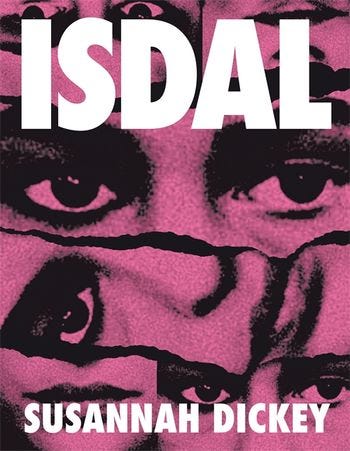
How do we write about violence without inflicting more violence? This is a central question in this innovative debut collection. I bought this book back in 2023 when it was shortlisted for the Forward Prize for Best First Collection because I thought the premise sounded really interesting, and it’s taken me (checks notes) two years to get round to reading it. That’s how far behind I am on my reading!
I read it cover to cover last night, staying up till 1am to do so. Whenever I stay up late, I often see a huge spider running across the floor of the living room, and true to form last night, a giant one ran across and hid inside a piece of folded over paper. It was so giant I heard its little feet tap-tapping across the paper. I decided I was too tired to do the glass and paper thing so I left it there to do whatever giant spiders do in the dead of night.
Isdal concerns itself with the real-life mystery of the ‘Isdal Woman’, whose burnt remains were discovered in Norway in 1970 and who has never been identified. The book is in three sections, all tonally very different. The first section interrogates the way female victims are talked about and dehumanised by the true crime genre, focusing on two presenters of a podcast. This first section is often playful, exuberant and full of energy. Here is the whole of a short poem early in the collection:
*More importantly!
Susannah Dickey

Two podcast hosts captain the story's bounce and narrative thrust!
He's English! She's Norwegian! They need listeners to bestow their trust
and invest in this ten-part audio description of cruelty.
If ratings drop there's been a failure of either execution or loyalty.
I also enjoyed the second section - a series of fragmented prose pieces of philosophical inquiry into who gets to tell a story of a violent death, and what that says about the life that proceeded it.
In the third section of poems, Dickey begins discussing a young girl who found the body of the Isdal woman, and her sister who she protected from ‘seeing’ the body.
The whole collection is about looking, who gets to look, who gets to look away, and about the difference between looking and seeing, between studying and witnessing. Describing the woman being found, Dickey writes ‘Soon after she was found. Although found implies / looking. Soon after, she was seen. By then, she wasn’t alive.’ The poems made me think about the ways we ‘see’ people, and how we miss people when they are in front of us, how lucky we are to have someone who ‘sees’ us for who we are.
You can order Isdal by Susannah Dickey here from my bookshelf at Bookshop.org
Foretokens
SARAH HOWE

I’ve just finished a week teaching an Arvon course at Totleigh Barton down in Devon, alongside Rishi Dastidar. Sarah Howe was our guest poet on the Wednesday. Sarah very kindly gave me an advance proof copy of her second poetry collection Foretokens. I loved Sarah’s first collection Loop of Jade which came out in 2015 (same year as my first collection!) and then went on to win the T.S. Eliot prize.
Reading her second collection this week has made me want to go and re-read her first collection again - partly because I’m fascinated by the leaps writers make from book to book, partly to marvel at the fierce intelligence that I remember from Loop of Jade, that is present once again in Foretokens.
There is very much the sense that this book has been woven together in a specific period of time - that time of early motherhood, when becoming a mother often asks us to confront our own experiences of being mothered. I think early motherhood can often give us this wild space to ask questions of the stories we’ve told ourselves about our own childhood, and the stories we’ve been told and this collection does all of this so thoughtfully and so carefully.
I read one of the poems in this collection “A History of my Relationship with my Mother in Twenty-three Arguments about the Laundry” in The Poetry Review in the Autumn 2023 issue, and loved it. It is deliciously witty, full of equal parts anger and love and tenderness. It begins
In my parents' house the second-smallest room and my mother's every
sixth waking thought is devoted to the laundry
As someone who also has a mother who is totally into laundry this made me laugh out loud, and think of Sunday evenings, which were the time my mother did the Ironing, which included all clothes including socks and knickers, teatowels, dishcloths etc. Everything got ironed. Which then makes me think of the wonderful Vicki Feaver poem “Ironing” - but I digress.
The laundry poem in Foretokens is a long poem, and comes towards the beginning of the collection. I think it’s an important poem in the collection as well because it encompasses so much of what Sarah does in other poems - the negotiation between being mothered and becoming a mother, the wrestling with anger is another thread that runs throughout the poems, the humour, the personal story and how this is intwined with social history - it’s all in this poem and then picked up later in the collection.
There’s a stunning sequence of poems written in the voice of objects in the Chinese Ceramics Gallery - you can read these over at the excellent The White Review.
The last poem in the collection is called “An Error, A Ghost” and feels very much as it it borrows from the world of the lyric essay, threading multiple stories and time frames together, using traditional lyric poetry interspersed with prose poems/prose fragments to explore a personal and social history. I found this poem deeply moving when I read it in its exploration of what we know and what we don’t know, or can’t know when it comes to our family history. I have been wanting to write about my nanna (my maternal grandmother) for a long time but not quite knowing how or where to start, and this poem gave me some ideas, and perhaps even permission to build what I want to write about her from fragments, and to lean into the blank or unknown spaces.
You can order Foretokens by Sarah Howe from my bookshelf here at Bookshop.org
Minx
KAREN DOWNS-BARTON
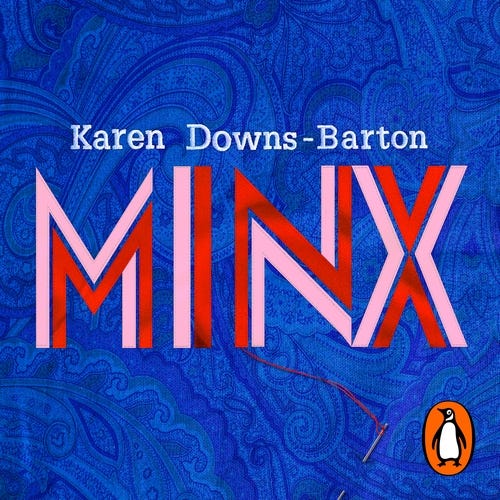
I was lucky enough to be the examiner for Karen’s PhD, undertaken at Kings College, London with Sarah Howe as her supervisor. Minx is Karen’s first full-length collection (following her 2023 Poetry Business pamphlet competition win for her pamphlet Didicoy).
There are some interesting parallels with Sarah’s collection as well in the excavation of personal and social history and all the ways that of course these two things intersect. The collection is in three sections “Poggadi Mirnomos: Broken Silence”, “The Home for Crying Children” and “The Bastard Files”.
This collection kind of broke my heart - in here are poems which examine the experience of a Romani girl growing up in the Care system, and all the ways that the Care system, and care itself fails society’s most vulnerable children.
These poems are formally innovative. There are epistle poems, a multiple choice poem, and a series of variations on ‘immured sonnets’. A note in the back of the collection helpfully tells me that this was a form created by Philip Nikolayev. In Karen’s variations, the sonnet is imprisoned within a wraparound text so that there are three ways of reading - down the left hand side, the right hand side or straight across.
Throughout there is a sense that Karen is pushing at all kinds of boundaries - linguistically, lyrically and formally. I like how Fran Lock describes this in terms of the way that English and Romany languages meet in the poems in a blurb at the front of the book, that Romani ‘haunts English, troubling that unhomely home, making it strange to itself, willing it into miraculous and alarming new shapes.’
The collection starts with a poem called “Minx”, a kind of found poem defining the term from a dictionary and exposing the gendered and racial connotations embedded in the word. The final poem, in true style to the rest of the book is a variation on that most fiendish of forms, a specular. It’s a specular which kind of puts a mirror in the middle of the line as well as the middle of the poem. I think one of the things I most admire about this collection is the variations on recognisable forms.
If you would like to buy Minx by Karen Downs-Barton, you can get it here from my bookshelf at Bookshop.org
It is a comfort (oddly?) to know that your tbr pile goes back 2 years - worrying the speed at which you tempt me to add to mine