
Emergency Dream
on Polly Atkin, bogs, owls, pain, herons, hot days and more!

You might know Polly Atkin as a poet – her third collection of poetry, Emergency Dream has just been published by Seren. Her debut collection Basic Nest Architecture (Serene 2017) won a Northern Writer’s Award – and so did her second collection, Much With Body (Seren 2021), which was also a Poetry Book Society Recommendation.
Or you might know her as a writer of creative non-fiction, author of the biography Recovering Dorothy: The Hidden Life of Dorothy Wordsworth (Saraband, 2021), The Company of Owls (Elliot and Thompson, 2024), Some Of Us Just Fall (Sceptre, 2023), and most recently, Swimming the Seasons: A Freshwater Almanac (Saraband, 2026).You might have encountered her as Dr Polly Atkin, who lectured in English and Creative Writing at the Universities of Lancaster, Cumbria and Strathclyde. Or maybe she’s sold you a book in Grasmere’s Sam Reads, one of the loveliest independent bookshops in the UK.
You may know her as a disability activist, and a passionate advocate for access and inclusion. If you follow her on social media, you might think of her as a partly wild creature, most at home in lakes and rivers, companion of herons and hares, owls and badgers. Or if you read (and you should read) the chapter she co-authored in The Book of Bogs (Little Toller, 2025) then you’ll know her as a lover of moors and moss, someone who knows the value of bogs and the threats they face, someone who lives the interconnection of human bodily integrity and the health of the land.
And of course, she’s all of these things, and she’s a Good Egg, and a kindred spirit, and any trip to the Lakes feels a little incomplete if it hasn’t involved swimming with Polly; or eating cakes in Chesters and sharing the lonely exhaustion of chronic illness; or drinking tea in the evening light in the Moss Hut at Dove Cottage.
If this ruins my claim to objectivity when I say that Emergency Dream is amongst the best poetry collections I’ve read in recent years, I don’t mind. Because you can look to her almost-ludicrously-long list of awards and prizes – and to the fact that she has just joined the Forward Prize longlist with her poem Pain Parade.
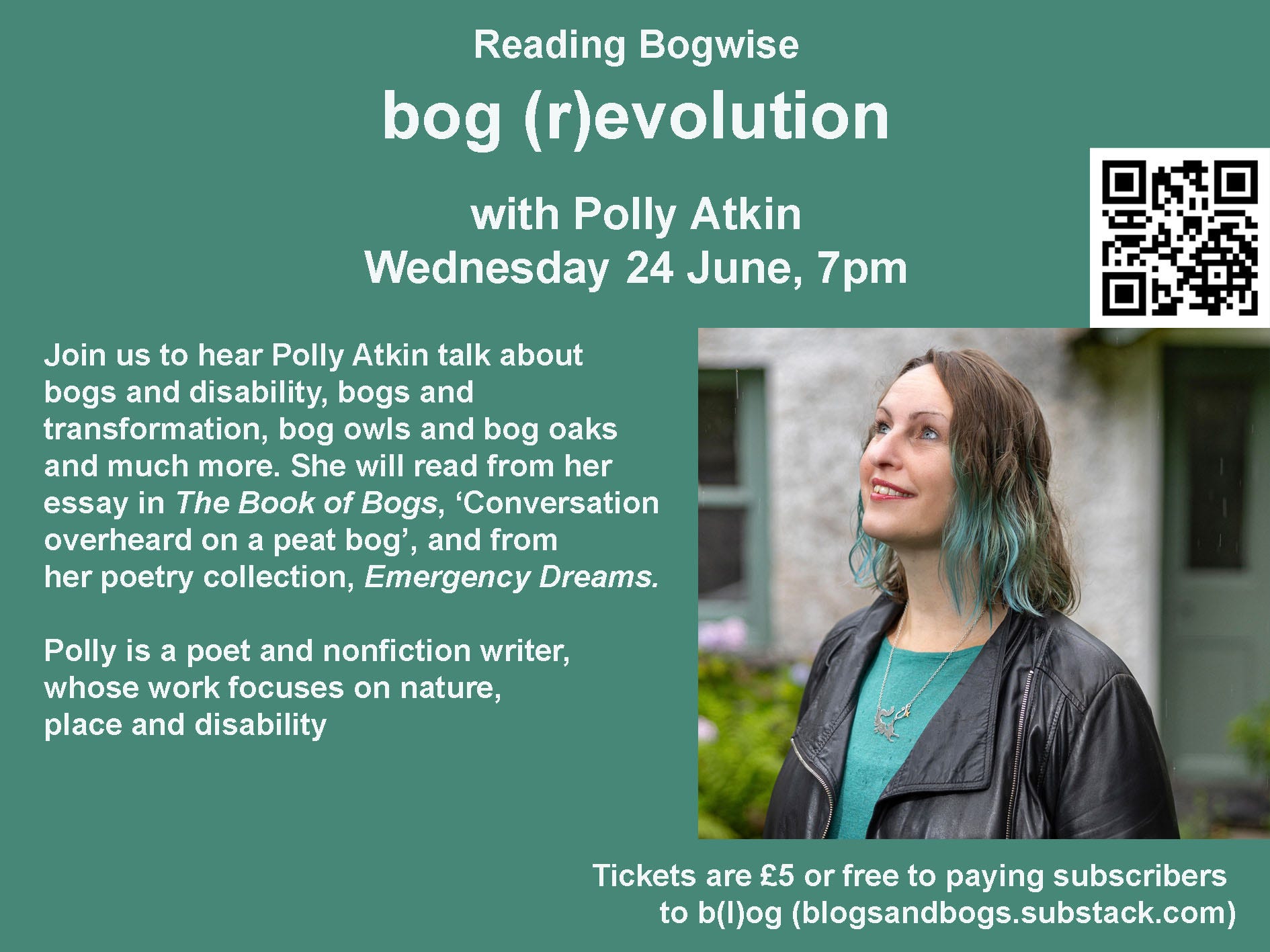
Or you could just join the Reading Bogwise series tomorrow night - tickets are available here, or are free to paying subscribers to b(l)og. Polly will read to us from the Book of Bogs, and from her new collection Emergency Dream. And from her wider work, from which we can expect owls, social justice, living with pain, herons, deer and who knows what else.
When I first read Emergency Dream earlier this year, this was my response:
“’Incandescence’ is the emission of light due to high temperatures. It’s distinct from ‘luminescence’: the giving out of light by a body which has not been heated. Polly Atkin’s Emergency Dream (Seren 2026) is incandescent: furious and bright. This is beauty experienced with hunger and urgency; this is a manifesto for finding a way; this is necessary reading.
Polly has forged a fearless new vocabulary for pain; walking into the storm and not expecting any answers or mercy from it, just the fact of forest and antler, river and fox. She has stepped beyond her self into our shared darkness, our shared light, and with passion and exquisite skill, she has brought back these words.
It strikes me on this June evening, simmering with heat and with excitement for the Wild Writing “Queer Nature” workshop I’ll deliver tomorrow morning (click on the link for tickets if you want to join the fun at 9am!), that I love how the collection rejects the usual binary oppositions of pleasure and pain, light and dark, human and nature, body and water, self and other. In its centring of the transgressive body, in its embracing of the communal, in its interconnection and multiplicity, in its love of what is overlooked, its fluidity, its uncertainty, its animism, its queering of perception – this is a conspicuously queer book, in the widest and best sense of the word.
This is something I’ll return to in future articles: how “queer” does not just refer to sexuality; how poetry itself is, in some important ways, queer. And of course, bogs are the queerest landscapes.
But for now, the sun is final setting, and the day is cooling, I’m off now to walk over the moors to Kim’s house because she’s sitting in the garden and she has beer, and the day is at last bearably cool, and this seems like a fine way to end a day, and an Substack article. Keep cool, everyone.
Sorry I missed this. I was at a reading by Manchester poet Aisha Akram in Barrow-in-Furness promoting her collection, “the cards I have been dealt”. Was it recorded?