
January Reading Diary
By Kim Moore

I’ve been reading a lot this month for January Writing Hours, but most of my reading has been individual poems rather than full books. However, I did manage to squeeze a pamphlet and a full collection in amongst all of that which you can read about below!
Welcome to all our new subscribers, our written posts are free, but if you’d like to become a paid subscriber, you get access to a monthly live event with myself and Clare, all for the princely sum of £4 a month. This month, our event is tonight and is a workshop on form. In March, we will be running an open mic where our paid subscribers can come and read their formal experiments! It’s not too late to join us if you would like to - just click the button below to take out a paid subscription.
Notes on Burials
Jayant Kashyap
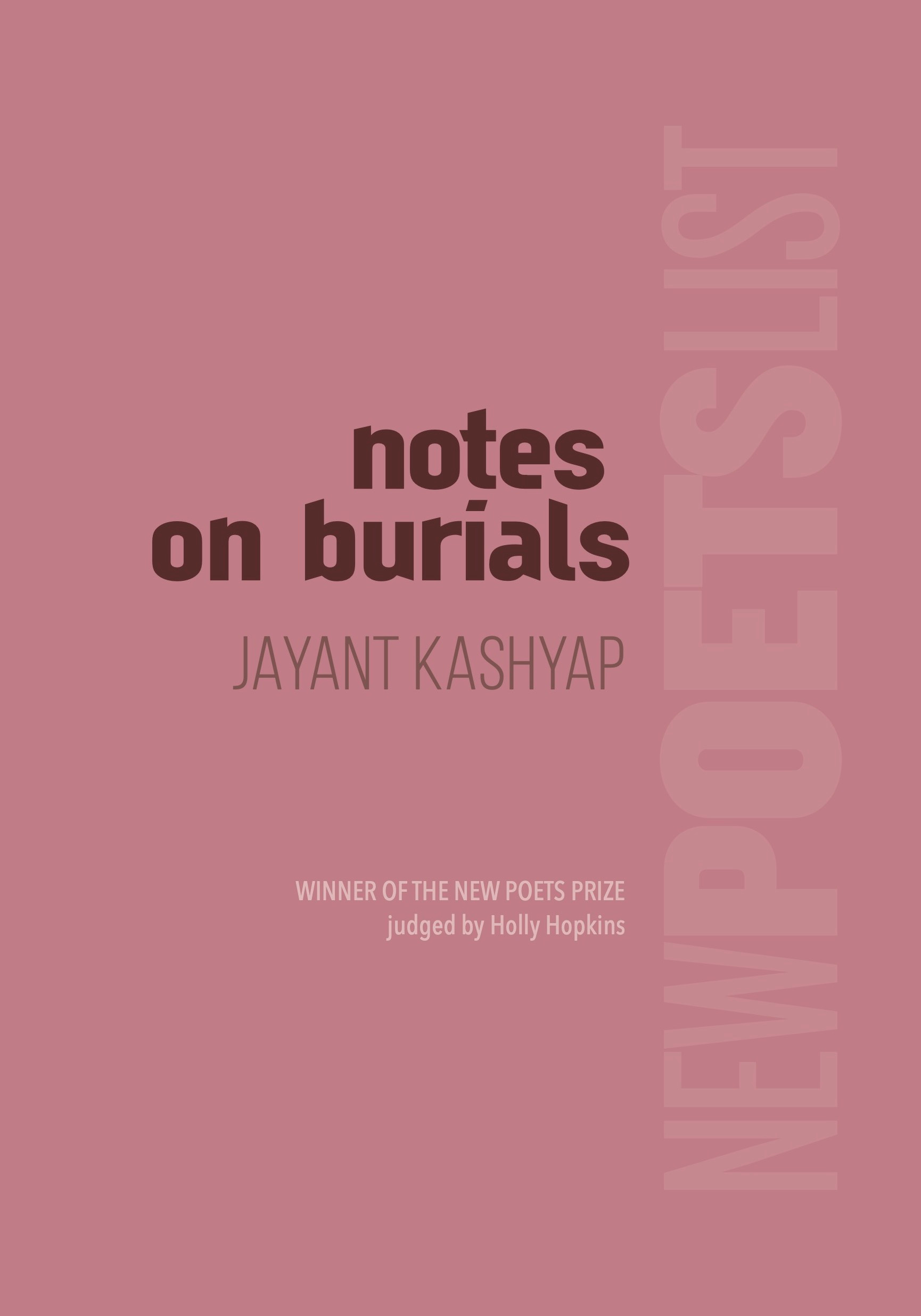
Jayant was a winner in the 2024 Poetry Business New Poets Prize, judged by the brilliant poet Holly Hopkins. I was really pleased to see that Jayant had won, because I recognised his work and style from a previous year when I’d judged the competition and he’d been shortlisted. In the back of the pamphlet, it was interesting to read that when he won, it was his fourth time of submitting - proving again that sometimes being published is not just a matter of talent, but of persevering, of finding a way of dealing with setbacks and rejections.
Notes on Burials is a wonderful pamphlet - held together by a concern and interest in what we bury, what we carry with us and what we leave behind, how we die, and by extension of course how we live. There is sometimes a surreal touch to the poems - in ‘but dogs don’t want their puppies buried’ the poem talks about a mother dog carrying dead puppies around and finishes ‘once I buried two dead pups in shallow ground / and next morning they were back up out of the mound playing with her’. This image has really stayed with me, and it’s an unsettling poem in terms of thinking whether this is an unreliable narrator, or whether this is surrealism, or the simple truth of a mistake or something else. Whichever, it often feels as if that border between life and death is more permeable than we usually appreciate in many of these poems.
I’m always interested in poems that are ‘notes’ and interested in the forms that poets use to convey the fleeting feeling of notes rather than finished thoughts. Mary Jean Chan has a great prose poem called Field Notes on a Family Meal which uses an unpunctuated block of prose to give that feeling. Jayant uses a fragmented series of statements that often trail off before the thought is completed, which also works really well to give that note-taking feeling.
There is also a playfulness to language here - the roots of words are often examined closely and held up to the light, but I think Jayant is also interested in how words slip in and out of themselves and into other words. In “Oak” the speaker asks us to “Imagine it standing / at the edge of a forest - hermit/heretic/heritage”.
There is a run of really moving poems towards the end of the pamphlet which finishes on “Prayer for My Mother As A Child”. This is a beautiful poem which starts “Let me carry myself like a quiet emptiness in her school bag”. This line almost made me cry - that wish as a child to go back to before you were born and see the mother as a person, before they carried you - both physically and metaphorically and spiritually. It’s a poem full of longing for the mother figure to live a life she did not get to live - the speaker says
                                                           I’ll go with her to places
in her dreams – places she wants to go to but will miss out
on: Manchester, Michigan

Mumbai,
the Disneyland, Niagara, and Mount Abu –
I also love that Manchester is listed in that list of places as well!
Buy this pamphlet if: you are interested in poems that puzzle at the roots of words and are interested in etymology, interested in poems that make the border between life and death feel less like a border and more like a curtain we can pass back and forth through, poems that are interested in ritual, poems that are serious in their playfulness.
You can buy Notes on Burials direct from the Poetry Business here
Midden Witch
Fiona Benson
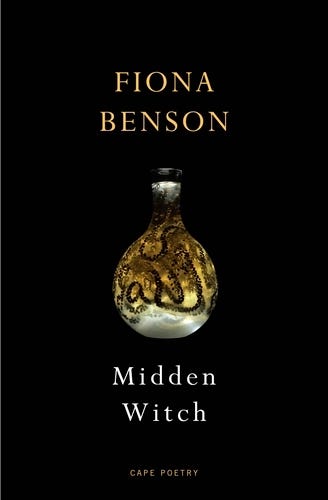
Fiona Benson is probably one of my favourite contemporary poets, and I always look forward to reading her next collection. Each book feels like a project, or a deep dive into something she has become obsessed, perhaps even possessed by. Her fourth collection Midden Witch was published by Cape last year.
The book starts with a tiny epigraph:
Anoint your eyes
with sap of common elder
and you may find
where witches gather
I love the idea that to even find witches, or to see them, you have to ‘anoint your eyes’ - you have to change the way that you see the world. We meet various witches in the pages of this collection - the Midden Witch, the Witch of Easington, Jenny Greenteeth, Leddy Lister, Elizabeth Lee and Mary Hunter. I believe that these witches are a mix of witches from folklore (i.e Jenny Greenteeth) and real-life women who were accused or spoken of as witches. There is the sense throughout the book that all of these women were once real people who didn’t fit into society for whatever reason and were scapegoated and abused.
The poetry in this book is rooted in the body, and there is a visceral quality to the writing about the body and violence - a quality that admirers of Benson’s work will recognise and admire from previous collections. One of my favourite poems is a long poem called ‘Babushka’ which juxtaposes ‘Babushka’ from myth in her search for the baby Jesus, and the speaker’s actual grandmother. The way Fiona writes about maternal lineage and the lineage of women which encompasses stories of witchcraft is always radical and always thought provoking.
There are also beautiful poems of observation in the natural world - again another favourite was ‘Snails’ in the plural voice of snails which finishes ‘We are erotic, beautiful. Listen closely; / we are speaking of softness and survival’. I also enjoyed poems like ‘Bowerbird’ where you can follow the speaker of the poem as they think through their assumptions and knowledge and rework their understanding of the world.
Buy this collection if: you love Fiona Benson’s work (you won’t be disappointed!), poems about witches, poems about close observation of nature, explorations of maternal lineage, and if you are interested in witches, folklore, mythology and hocan use these ancient stories to write hyper-contemporary poetry.
You can buy Midden Witch here from Bookshop.org
And if you’d like to hear Fiona read, I’ll be hosting her as part of the Wordsworth Grasmere ‘Go to the Poets’ reading series. This is an online event - please click here for more information. The open mic is now full, but plenty of audience tickets left.
Structure and Surprise: Engaging Poetic Turns
Edited by Michael Theune
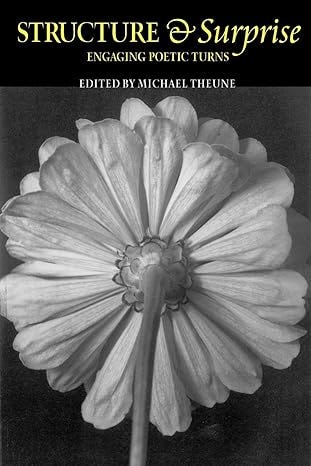
For anyone who attended January Writing Hours, the daily online writing workshop that Clare and I run throughout January, you will be well aware of my new obsession with this book. It’s a craft book that gives a new taxonomy or language to talk about the structure of poetry, as opposed to the form of it.
So the chapters of the book cover poetic structures such as ‘The Ironic Structure, the Emblem Structure, the Descriptive-Meditative Structure, the Concessional Structure, the Retrospective-Prospective Structure amongst others. The book comes with examples of each structure with thoughtful analysis, example exercises to have a go at writing your own in the back, and further poems as examples for each structure.
During January Writing Hours, I was staying one step ahead of everyone else, reading a chapter at pace the night before sharing my thoughts on it with over 250 people online. I now want to go back and read it a lot more slowly, and start to grapple with it a bit more.
I was introduced to this book by the mighty Roger Robinson whilst we were running a course together last summer at Ty Newydd, and it’s definitely a book I’m going to be using in my teaching going forward.
There is also a fantastic website with supplementary material to the book as well which is well worth looking into.
Buy this book if: you are interested in finding other ways of thinking about poetry, you enjoy intelligent analysis of poetry, if you want to find other ways of thinking about your own writing, if you teach poetry and want to refresh your practice.
You can buy Structure and Surprise: Engaging Poetic Turns here.
Hi Kim
I think the link to purchase Michael Theune’s STRUCTURE & Suprise - Engaging Poetic Turns is missing from your recent email.
I’m keen to buy the book, I’ve had a web search and found only an Amazon route to it. Is Amazon the only possible place to purchase from?
One more question, sorry: is Theune the author or just the editor, as is stated on the cover? I’m a little confused as to who has actually written it.
Cheers for now
Jake
Jake Hughes
Loved hearing you yesterday on 'The Verb', Kim. I recognised your voice immediately!