
July Reading
By Kim Moore

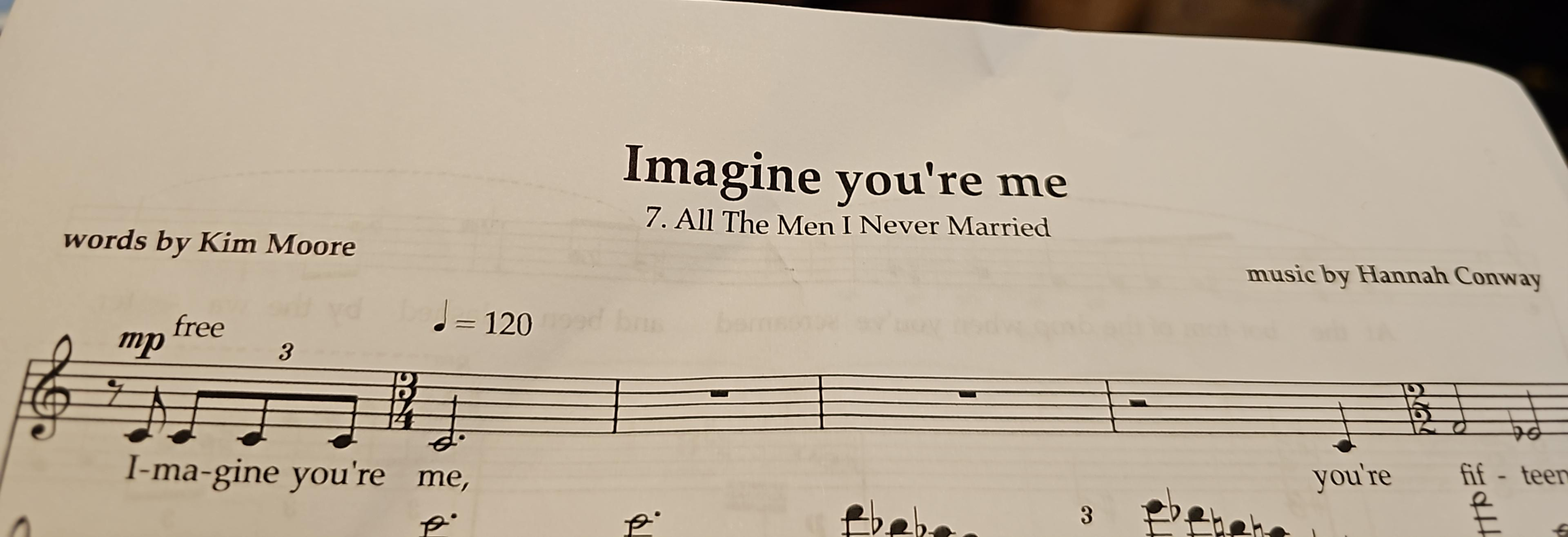
July was very busy so my reading is a little thin this month! I had a day away in London working with the fabulous composer Hannah Conway from Sound Voice, who has set one of my poems from All the Men I Never Married as an operatic aria. I got the chance to hear the poem, sung by the wonderful Charmian Bedford and then take part in R & D with Hannah and Dramatist/Librettist Hazel Gould. By a strange set of coincidences, we discovered that Hazel has also worked with my partner in crime Clare Shaw on an opera! It was an amazing and invigorating day and it felt pretty special to see my work taking on a new life and becoming a different type of animal. We are hoping to continue working on this to produce a performance of some kind, so watch this space!
I also went away on an overnight retreat for researchers interested in interdisciplinary research and met some really interesting people - both of these projects have been funded by internal funding at Manchester Metropolitan University. It still blows my mind that I get to do exciting things like this as part of my job.
I’ve also been meeting with lots of my MA students throughout July to discuss their final dissertations, and went to see my colleague Ntombizodwa Nyoni’s play Liberation at the Royal Exchange. It was fascinating, and interesting and challenging and thought-provoking. I left wanting to find out more about the historical time period it covers and also very grateful that I get to work alongside such talented writers.
I ran an online workshop for the Poetry Business during July as well. There are still workshops going on, so it’s definitely worth keeping an eye on the website as they have a wide variety of tutors and approaches. Which brings us to today - we’ve all just got back from a family holiday in Spain. We went all inclusive in a hotel, queued for sun beds and the buffet and embraced the chaos and noise of eight days by the pool and getting on and off the water slides.
It was one of my favourite holidays in a long time. Yes, all inclusive holidays are cheesy, and kind of terrible, but I loved not having to cook or wash up. I loved watching my daughter grow in confidence in the water every day, becoming more and more independent, that pull of love and terror and pride as she moved further away from me. I loved watching her make friends with other children and seeing how she gives her heart so completely, how she falls in love with people. I loved that I did get some time to sit by the pool and read, but that I also found it easy to be present and join in with the water slides.
I didn’t love having to get up early in the morning to go for a run - in fact, I never really managed an early morning run. I think my earliest run was 8am and the temperature (even in the middle of the night) never really dropped below 22 degrees, so I just ended up shuffling along the promenade and back in the heat, feeling like an extra from The Walking Dead.
All this is to say, the reading is a little thin on the ground this month, but I did enjoy what I managed to read.

I’ll be hosting David as the guest poet for the next “Go to the Poets” online event with Wordsworth Grasmere, so I have read his book partly to prepare for this, but mostly because he is one of the poets whose new work I always look forward to arriving. Passion has just been published by Carcanet and it is a wonderful collection of poems. If you know anything about David’s work, you won’t be surprised to hear that his poems are filled with the natural world - in this collection in particular, birds of every description fly in and out again.
I am becoming a little obsessed with the epigraphs that poets put at the beginning of their books. David has chosen a quote from Rainer Maria Rilke:
    The work of the eye is done.
Go now and do the heart-work on
the images imprisoned within you.
I like this quote. It makes me want to go and do what he says - and what a beautiful description for the work that we can do as poets - the heart-work. I love writers that tell you to do something - my other example of this (apart from Malika Booker telling me to stop faffing and write my book) is an Adrienne Rich quote “You must write, and read, as if your life depended on it.” When Adrienne Rich, or Rainer Maria Rilke, or indeed Malika Booker tells us to go, we go.
Anyway, back to David’s book - it starts with a really beautiful and poised ghazal: “The Mist Net Releases Her Birds”. This poem enacts so many of the themes, but also the approach to language that a reader will find in the rest of the collection. The form of the ghazal with tis repeating lines and words calls attention to language as a physical, made and playful thing. This ghazal is of course an English version of what is an Arabic form. This hovering between two cultures is something that is enacted throughout the book in different ways as David draws on Romany language and storytelling, mixing in some (not all) of the poems. Interestingly, some of the words I’ve begun to recognise now after examining a PhD by Karen Downs-Barton, another writer who draws on Romany heritage and uses the Romany language in her work. I remembered ‘vardo’ means caravan for example, without having to refer to the glossary.
The ghazal sets up the poem as a real place that contains morning mist and birds from the first couplet:
You open a window to the morning mist of this ghazal.
I release songbirds from the mist net of this ghazal.
The poem becomes a place of power - the ghazal not only has morning mist and birds inside it, it has gables - it is a house. It turns the speaker and the receiver of the poems into birds, and eventually by the last line, the ghazal becomes a bird. It’s a poem with transformation and the connection between human and animal at its heart.
This is only supposed to be a very short enthuse about each book, rather than a full review, but I will leave you with this final quotation which is from a poem called “A Man Of His Time” about the speaker’s father who is abusive. In the middle of the poem, the speaker describes what he does when the father is shouting:
The way out was a space I made in me.
An ice floe at the polar edge of earth.
I froze inside his flow and held my breath

and waited for him to stop or tire of me
For those of us who have lived with violence and found a place inside ourselves to retreat to whilst it was happening, long before we found the path in the outside world, these lines I’m sure will resonate.
Flights
Olga Tokarczuk
translated by Jennifer Croft

This was a birthday present from my friend Amanda Dalton. Bearing in mind my birthday was in October, it’s taken me a while to get round to reading it. I am ashamed to say I hadn’t read any of Tokarczuk’s work before. She was awarded the 2019 Nobel Prize in Literature, and Flights won the 2018 International Booker Prize. She’s also published nine novels, three short story collections and her work has been translated into thirty languages.
This is a genre-bending book if I’ve ever read one. The blurb on the back says it’s a ‘novel about travel in the twenty-first century and human anatomy, broaching life, death, motion and migration’. I’ve read a fair bit of non-fiction now that manages to blur the boundaries of genre and it’s the type of non-fiction I really enjoy, but I’ve not read a novel that does it. Sometimes I felt as if I was reading non-fiction, sometimes it felt as if I was reading a short story, sometimes an essay, sometimes memoir.
There are titles used throughout and sometimes these indicate that we are moving on to another story, another subject, but sometimes these titles are actually just sub-headings - for example, the book begins (I think) in the territory of memoir with the sub-heading “HERE I AM” but then we get multiple sub-headings which stick in this territory of memoir and first person, until we get to page 30 with the heading “KUNICKI: WATER (1) and then begins an absolutely compelling story (short story?) told in third person about a man whose wife and child mysteriously vanish on a holiday on a Croatian island.
This was one of my favourite parts of the book - I found it utterly compelling and felt immensely annoyed at not knowing what happened to the wife and child. We do find out some of what happens right towards the end of Flights, but there is still plenty of mystery and strangeness left humming away at the heart of this story.
I took this book on holiday with me and whilst on the face of it, it might not seem like an obvious holiday read, the small sections, the jumping through time and from first person to third person narration, from genre to genre was perfect for reading in the little bits of time I managed to carve out whilst taking part in a slightly manic family holiday at a hotel with a water park.
Here is the first paragraph, which I read multiple times because it’s so beautiful, and such a wonderful example of lyric prose, which is a term which often gets bandied about without a clear definition - but this passage really embodies what it means.
HERE I AM
from Flights by Olga Tokarczuk

"I'm a few years old. I'm sitting on the window sill, surrounded by strewn toys and toppled-over block towers and dolls with bulging eyes. It's dark in the house, and the air in the rooms slowly cools, dims. There's no one else here; they've left, they're gone, though you can still hear their voices dying down, that shuffling, the echoes of their footsteps, some distant laughter. Out the window the courtyard is empty. Darkness spreads softly from the sky, settling on everything like black dew."
ACTS OF CREATION: ON ART AND MOTHERHOOD
HETTIE JUDAH
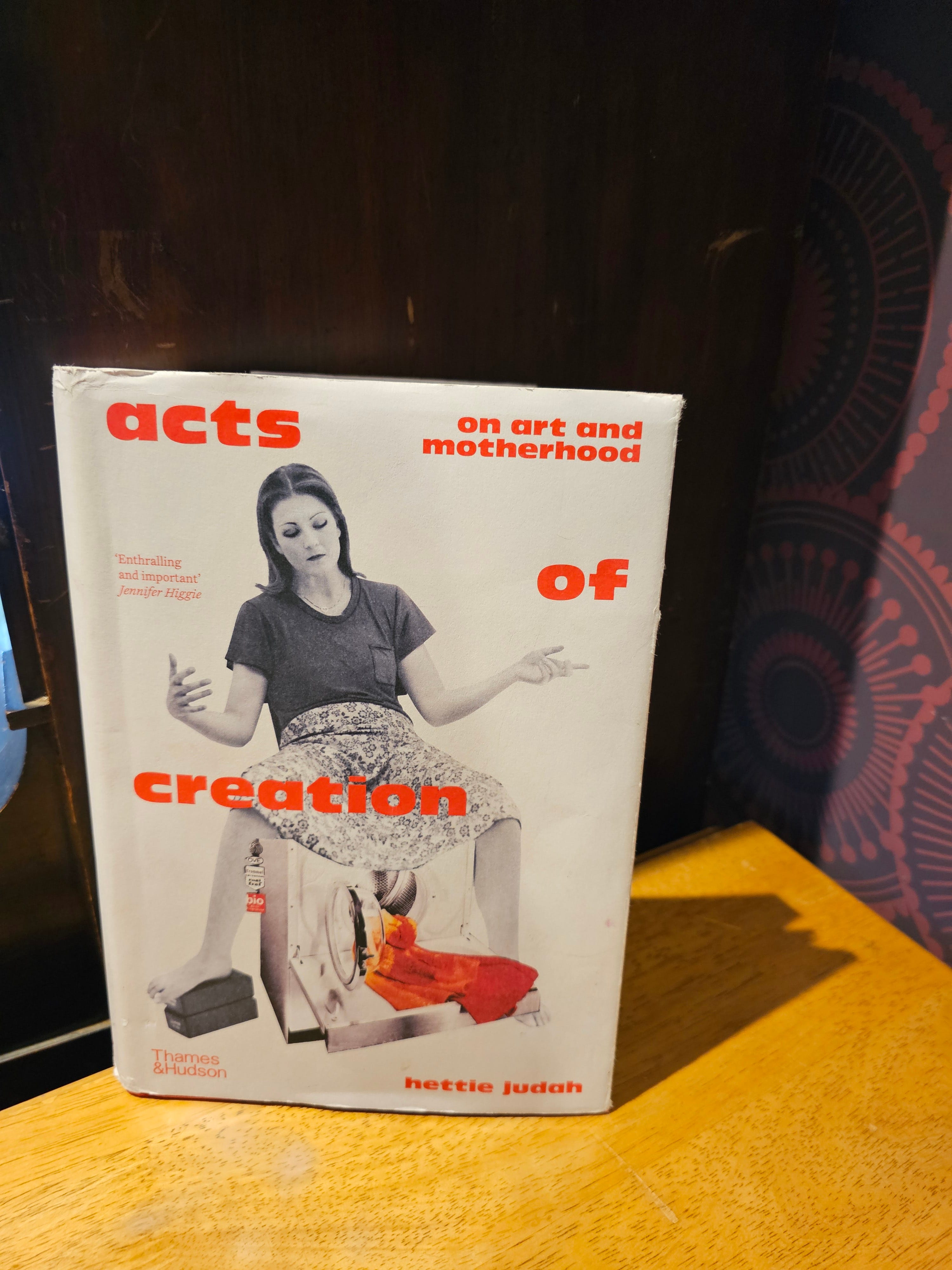
My journey of discovery with art continued this month. I bought this book last month when I visited The Hepworth Gallery in Wakefield, mainly because of this amazing image by Marlene Dumas The Painter, 1994 near the beginning of the book. As Judah says “To me, The Painter speaks of the conditions of making art as a mother, of having another being standing between you and your work.” Judah points out that the child in this painting is a little monstrous. She is huge, and at least one of her hands could be covered in blood, not red paint. But there is something beautiful in the way that title hovers between bestowing itself on the child who is pictured or on the unseen mother-artist. And there is something beautiful in the way the child is acknowledged as a creative being in her own right, not just someone who is in the way of the real artist, or perhaps the painting allows the complexity of both of those things being true. There is an interesting article here over at the Guardian about Marlene Dumas, which includes The Painter.
I also really loved Tala Madani’s Shit Mom (Remodel) from the series Shit Moms (2019 - ) which I came across in this book. This led to me falling down an internet rabbit hole and trying to find more of the series - you can see some of them here.
I would really recommend this book to any parents out there who are wondering how to fit their creative life into and alongside their life as a parent. The book is divided into 7 sections: "Mothers divine”, “The mother in western art: a history in fragments”, “the artist as mother”, “creation”, “maintenance”, “loss” and “mothering: the family reborn”. It does away with the idea that mothering and parenting can’t co-exist alongside a creative life whilst acknowledging the very real difficulties of doing so. I love this interview with Tala Madani where she talks about how the series came about - that she didn’t paint for eight months after giving birth, and then when she did she was so repulsed by the ‘kitschness’ of what she saw that she smeared the painting. I think I like this interview because it confirms so much of what I believe is true about writing - that first of all you have to show up, that you are allowed to have strong feelings, that everything, even the mistakes and the wrong turns are part of the process.
So there you go - July recommendations! I will be back with some August recommendations in a few weeks time. Do let me know if you’ve read any of these books and what you think of them.
I have just finished reading Olga Tokarczuk’s novel ‘Drive Your Plow Over the Bones of the Dead’. Every chapter begins with an epigraph or quote from William Blake. I now have another book by Olga to read. Thank you.