
October Reads
By Kim Moore

Morning all - in the post below you will find some of the books I’ve been reading over October, and also news of an online event that I’ll be hosting with the brilliant Harry Josephine Giles. There are still some open mic spots left so if you’d like to read, head over to the event page here and instructions on how to sign up (along with our theme for this month) will be there. We screenshare all poems and there are bursary tickets available for anyone who needs one to attend.

Here are my October reads - I’ve been making sure I read on my commute on the train instead of wrestling with the intermittent wifi signal and this is the result! Some brilliant books this month…You can buy any of these books from my bookshelf at Bookshop.org, or there are links to the individual books in the book titles.
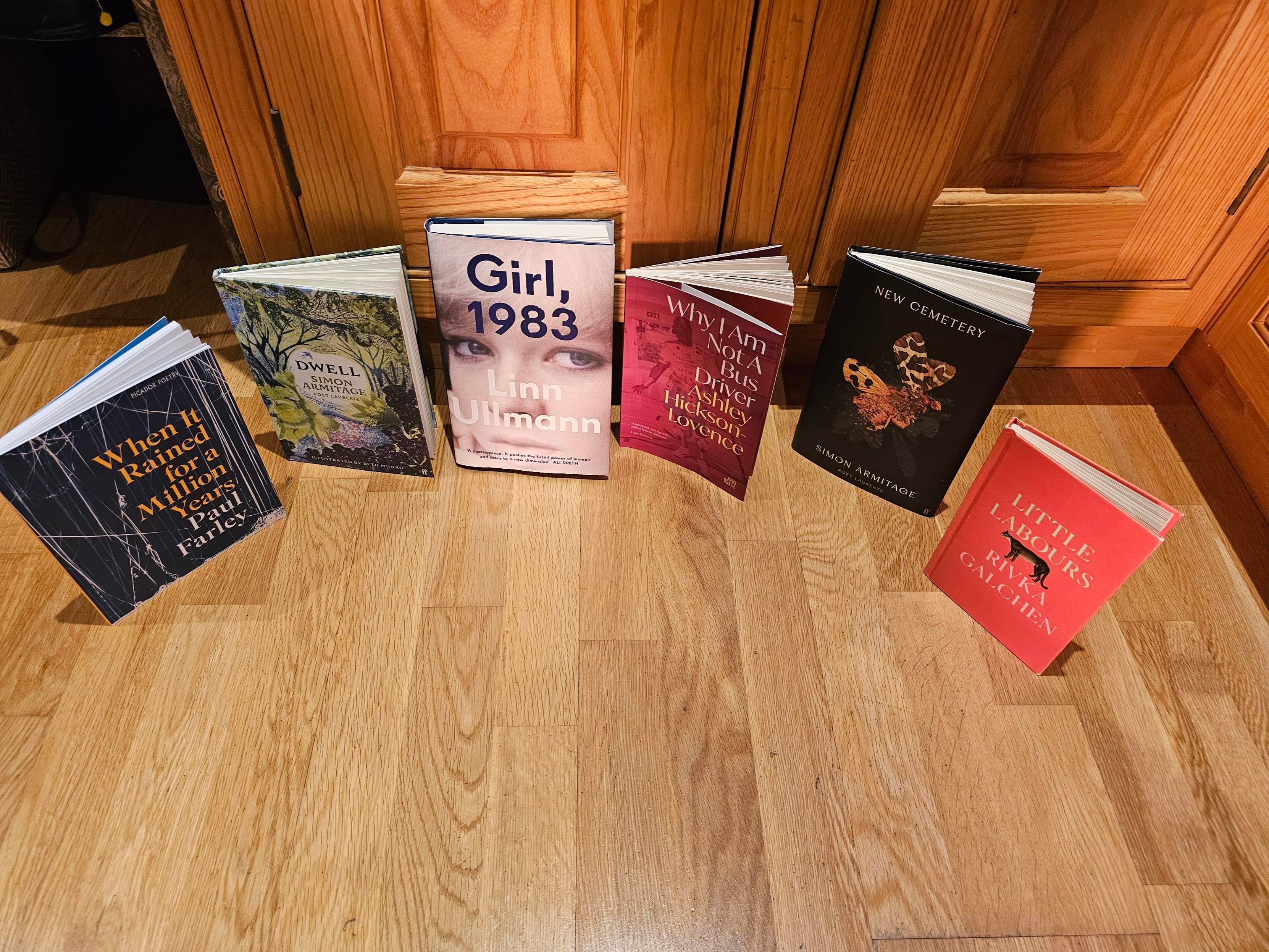
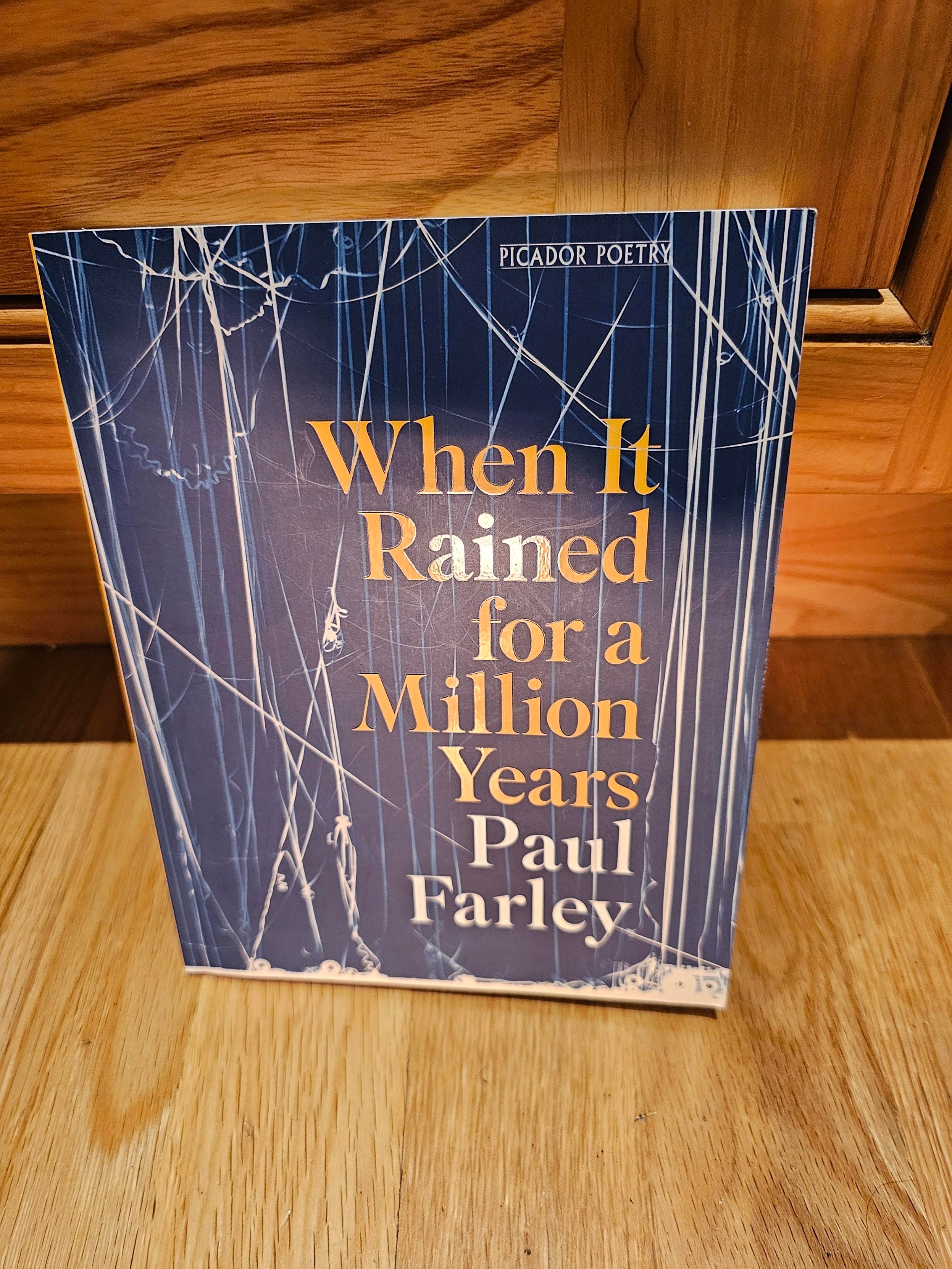
When It Rained for a Million Years
Paul Farley
Picador, 2025
Paul Farley read recently at Manchester Poetry Library as part of the ‘Reimagining V’ event. ‘V’ is the iconic poem written by Tony Harrison during the Miner’s strike. I met Paul before the event and we realised to our astonishment we had never met before - which in the tiny poetry world we move in is kind of astonishing. At the bookstall before the event started, I opened Paul’s book to a poem called ‘In One of Your Urgent Poems’ and read the first stanza:
It was like being the I in one of your urgent poems,
an I that moved dreamlike with a strange purpose.
A drunk I, still stupefied from a club,
swaying home on autopilot. A fox
I trapped by its instincts in a security light.
And then immediately fell into a particular state which I haven’t felt for a long time, which is a mix of excitement and enthusiasm, like remembering why you loved something that you have only been feeling fond of for a while. So then I bought the book, even though my washing machine had nearly set on fire the night before (another story) forcing me to buy a new one to replace the smoking remains of the old one, sending me down into overdraft hell once again.
But at least I have this amazing book to keep me company! And anyone who knows me knows that I can’t resist poems that think about the I…I am now starting to daydream about a Candlestick press anthology of I poems, containing Sharon Old’s “Take the I Out”, and Paul Farley’s “In One of Your Urgent Poems” and Moniza Alvi’s “Upholding the I” and my “Loving the I”…
Anyway, back to When It Rained for a Million Years. It’s currently on the shortlist for the T.S Eliot prize. I’ve only read three of the other books on the list - Sarah Howe’s Foretokens, Isabelle Baafi’s Chaotic Good and Nick Makoha’s The New Carthaginians. I suppose this book is perhaps the one most rooted in the lyric tradition - but I loved the way Farley writes about masculinity and class and violence and the home in a poem like “The Horse”, which turns an unnamed male figure into a horse in an extended metaphor that runs for the whole poem.
To me it reads like a poem that’s in conversation with other poems about work - it reminded me of Philip Levine’s “What Work Is”. It tracks the dawning of understanding in a child when they realise their parent is not all powerful, but is instead a small part in the great machine of work, of capitalism:
...we thought he was running
for guineas, for gold,
where we thought he was jumping
the fence of the world,
not ploughing a scrubby old
plot in the cold,
or hitched to a cart
or being used on the road.
Another of my favourites is “King Carbon”: ‘A King who ordered his palace torched / so he’d feel more at home, / who looks at the overnight reports / on a charred and scaly throne'. I couldn’t help thinking of some of our illustrious politicians when reading this.
I could name many more poems to look out for, but I would really recommend going out and buying it - if you’re interested in how a working-class sensibility can drench your poems without them always being explicitly about class, if you like lyric poems that are aware of the tradition they are writing towards and against, if you like poems that often reflect on the act of writing itself in clever and often funny ways, if you like darkness and tenderness in your poems, then this is the book for you!
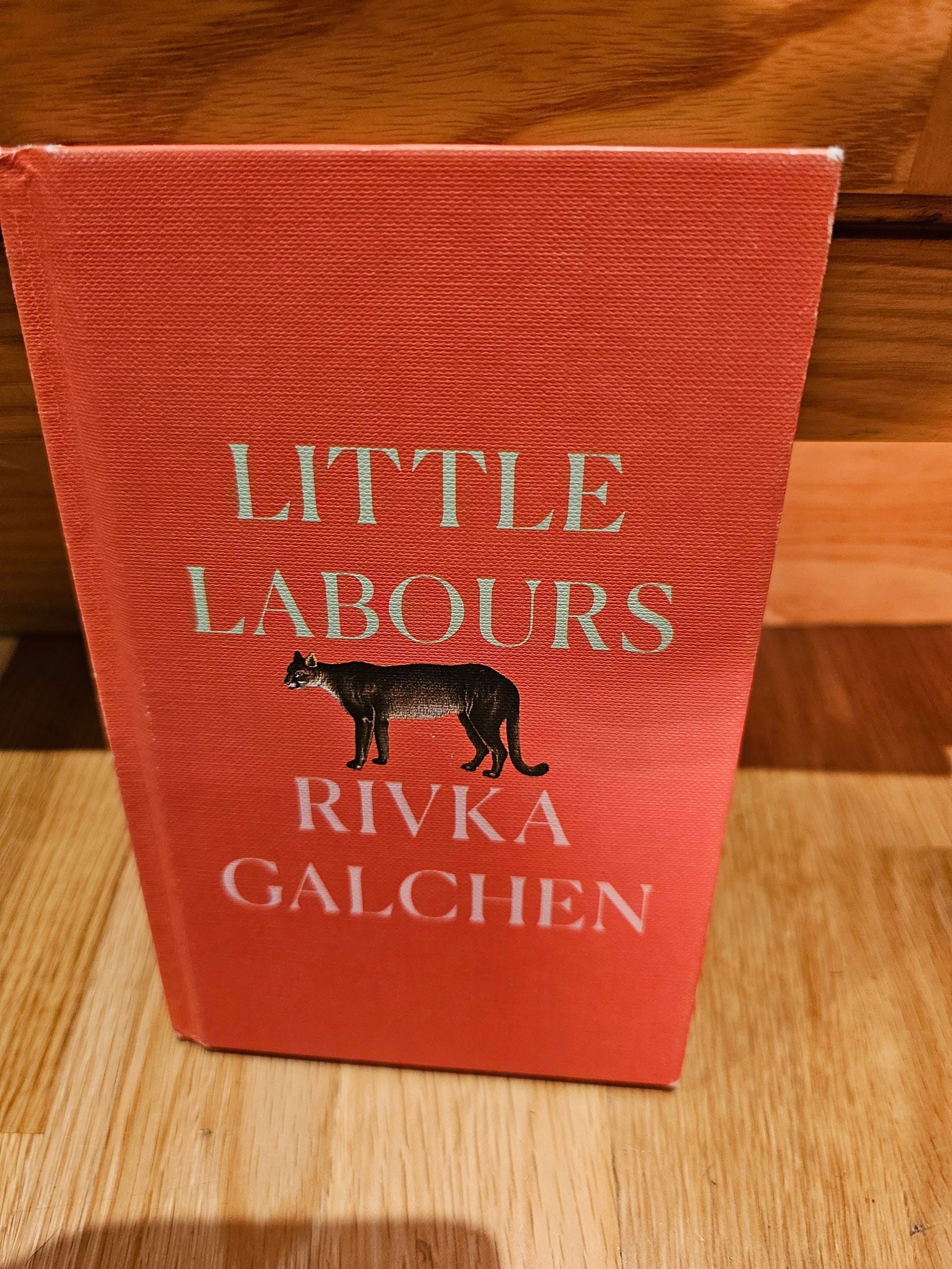
Little Labours
Rivka Galchen
Fourth Estate, 2019
Amanda Dalton lent me this book when I told her I was trying to write about motherhood. It’s a tiny book, full of short essays about the early days of motherhood. It’s beautifully written with both detachment and tenderness and made me wish I’d kept better notes (or indeed any notes) about my own experience of motherhood.
It is a book about the destabilization of motherhood, made up of fragments, impressions, literary allusions, about what we want to write about as opposed to what we have to write about. It’s form takes inspiration from Sei Shonogan’s The Pillow Book, written in the 11th century, which Galchen references in Little Labours as ‘not a novel and not a diary and not poems and not advice, but it has qualities of each, and it would have been understood at the time as a kind of miscellany.'
It is one of those books that I wish I’d written. Some favourite quotes:
“In late August a baby was born, or, as it seemed to me, a puma moved into my apartment, a near-mute force, and then I noticed it was December, and a movie was coming out on what is sometimes called the day of the birth of our savior.”
“I sometimes share the elevator with a woman who is very cheerful and mean”
“My life with the very young human resembles those romantic comedies in which two people who don’t speak the same language still somehow fall in love”
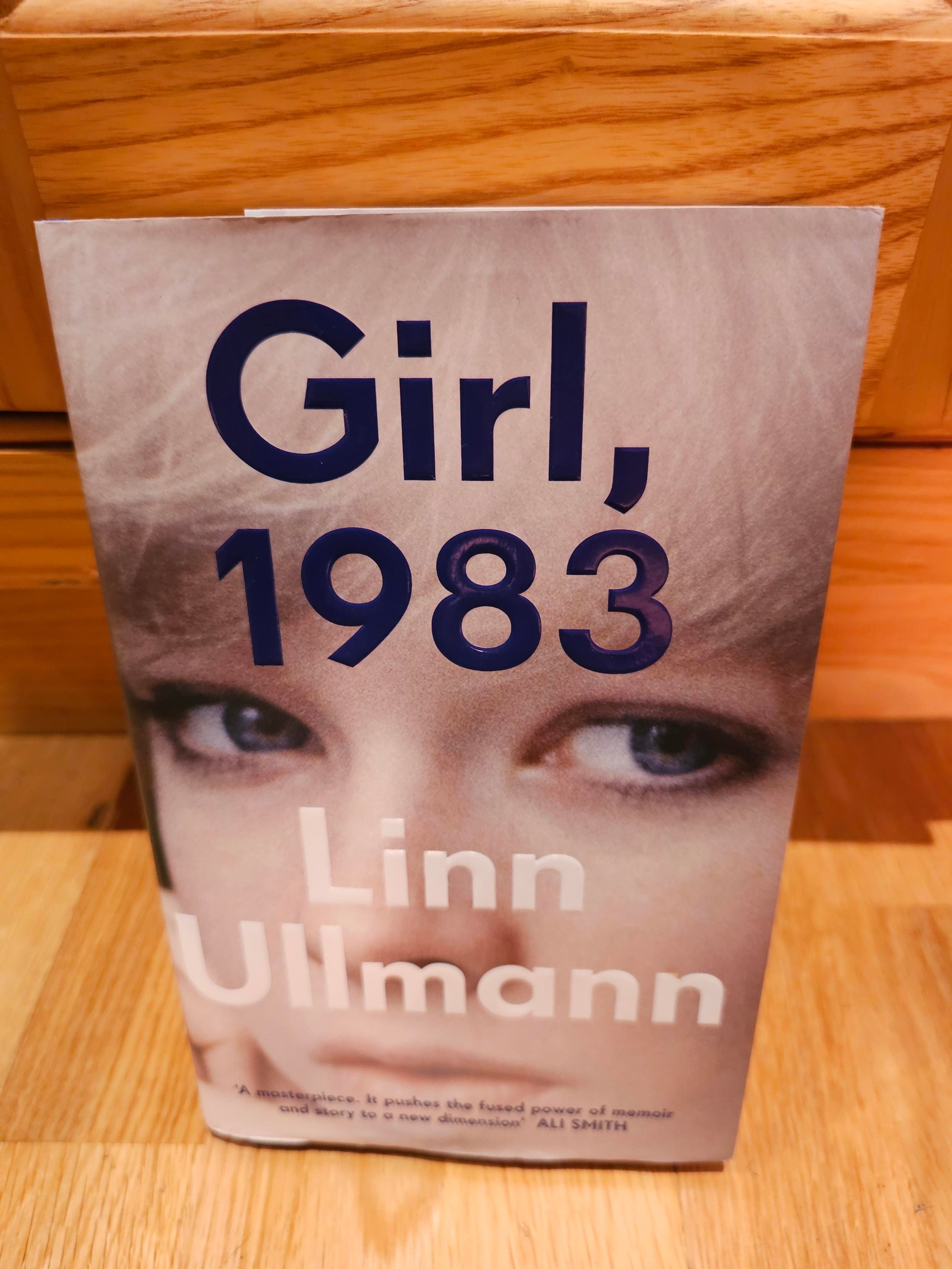
Girl, 1983
Linn Ullmann
Hamish Hamilton, 2025
This was a present from Amanda Dalton for my birthday at the beginning of the month. It’s exactly the kind of book I love - a hybrid memoir/novel/autofiction. The writing here is a kind of tender retrieval for the teenage self buried inside the adult woman. I felt waves of sadness when I was reading this and recognised so much of the territory covered here - there are complex negotiations with desire, sexuality, the power and powerlessness of a teenage girl. It didn’t make me look at my own girlhood differently - instead it asked me to look again at things I’d not looked at in years, it showed the circular nature of trauma, the fragmentation of memory, the difficulty of getting to an absolute truth. It made me feel more empathy for myself as a girl as well, for all girls who have to navigate their way through a world that often sees them as disposable.
I knew I would love this book when I read the first paragraph which takes us right up close to the heart of what will be unfolded later on:
"I'm sixteen years old and fold my arms on the tall table in front of me, rest my cheek against one arm and look into the camera. The photograph, which no longer exists and which no one apart from me remembers, hints at my bare shoulders. I think the idea is to suggest nakedness, that all a young woman needs to wear when setting out in the world is a pair of long earrings."
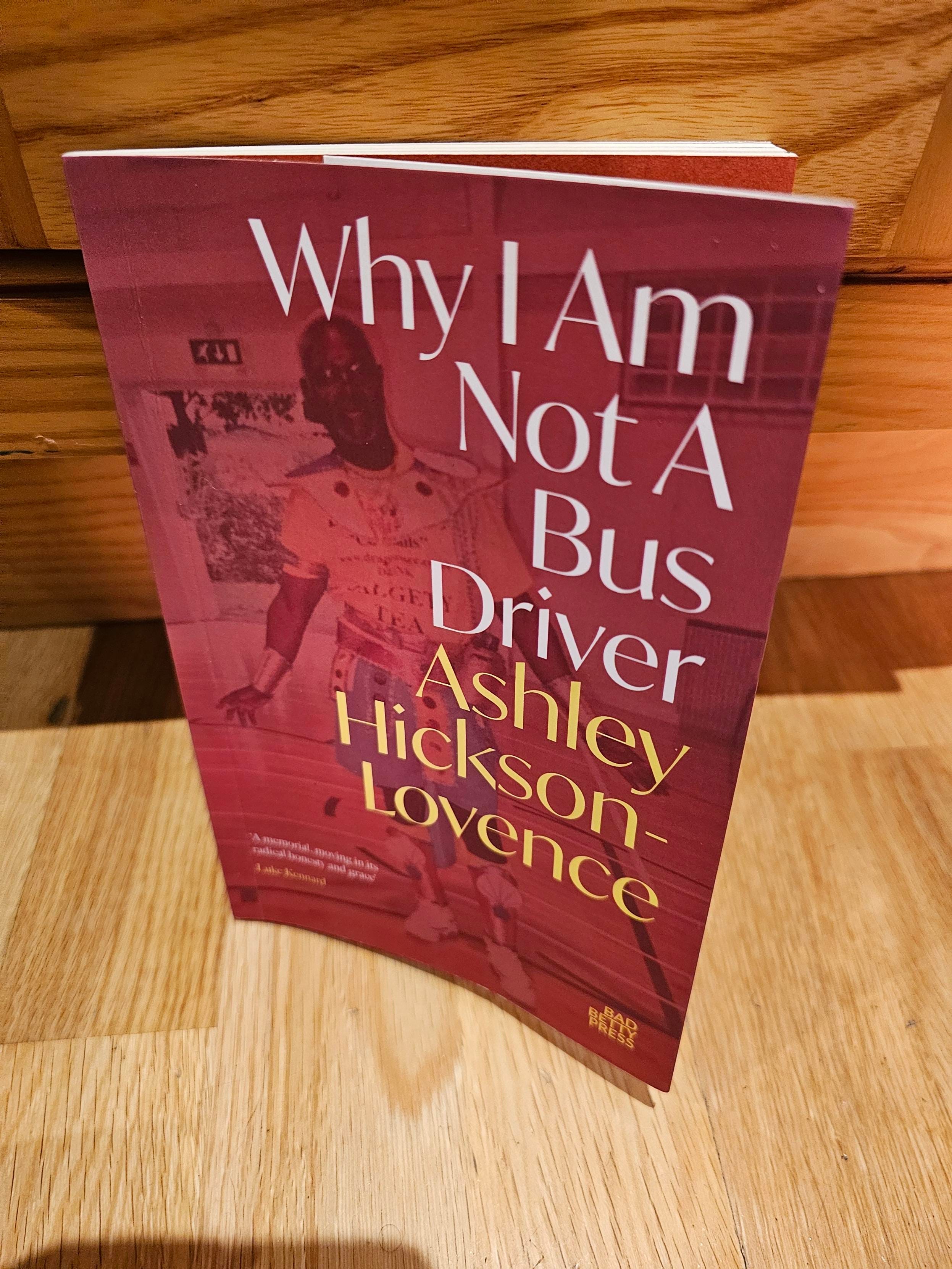
Why I Am Not A Bus Driver
Ashley Hickson-Lovence
Bad Betty Press, 2025
The lovely editors at Bad Betty Press often send me new collections, and this one has been on my to-read pile for quite a while. I really enjoyed this one - it’s an unusual poetry collection in that the poems are interspersed with photographs - mainly of the poet’s grandfather, who is the subject of many of the poems in the collection. I found these photographs very moving - one shows his grandfather in a wrestling pose, the next a few poems later shows his gravestone. Later there are photographs of the grandfather and a baby, presumably the poet.
The title of the collection is a homage to the Frank O’Hara poem ‘Why I Am Not A Painter’. The O’Hara poem begins “I am not a painter, I am a poet. / Why? I think I would rather be / a painter, but I am not…” and Ashley Hickson-Lovence’s poem starts “I am not a bus driver, I am a writer. Why? / I think I would rather be a bus driver, but I am not.” In fact, the last section of the book contains a run of poems after O’Hara which use O’Hara’s style of an appearance of stream-of-consciousness, lots of exclamation marks etc but locate this in London rather than in New York.
The first poem in the collection is called “Greenford Avenue” and I used it in a workshop with some undergraduate students a few weeks back. I wanted them to think about what a first poem tells us about a poet, not just details about their life, but about their approach to language, and how what is in the first poem in a collection might foreshadow what else is going to happen in the book.
The poem is a direct address to the grandfather, and it sets up both the love between them, but also the distance between even loving relations when they move in two different worlds. I’m finding myself drawn more and more to poets writing from these spaces - writers who burst from the family tree with no sign they were coming when they look back at the careers chosen by their family. “Greenford Avenue” begins:
"Good with our hands but in very different ways,
I wouldn't know where to start under
the bonnet of a broken-down car
or changing a flat tyre and you wouldn't
understand the point of me writing these poems..."
I also like poems that are about masculinity and the messages passed down about masculinity. If you are interested in poems that tackle masculinity and black masculinity in particular and in how poetry can tell a personal history and weave it into social history and of how the everyday can be turned into poetry then I would definitely recommend this collection!
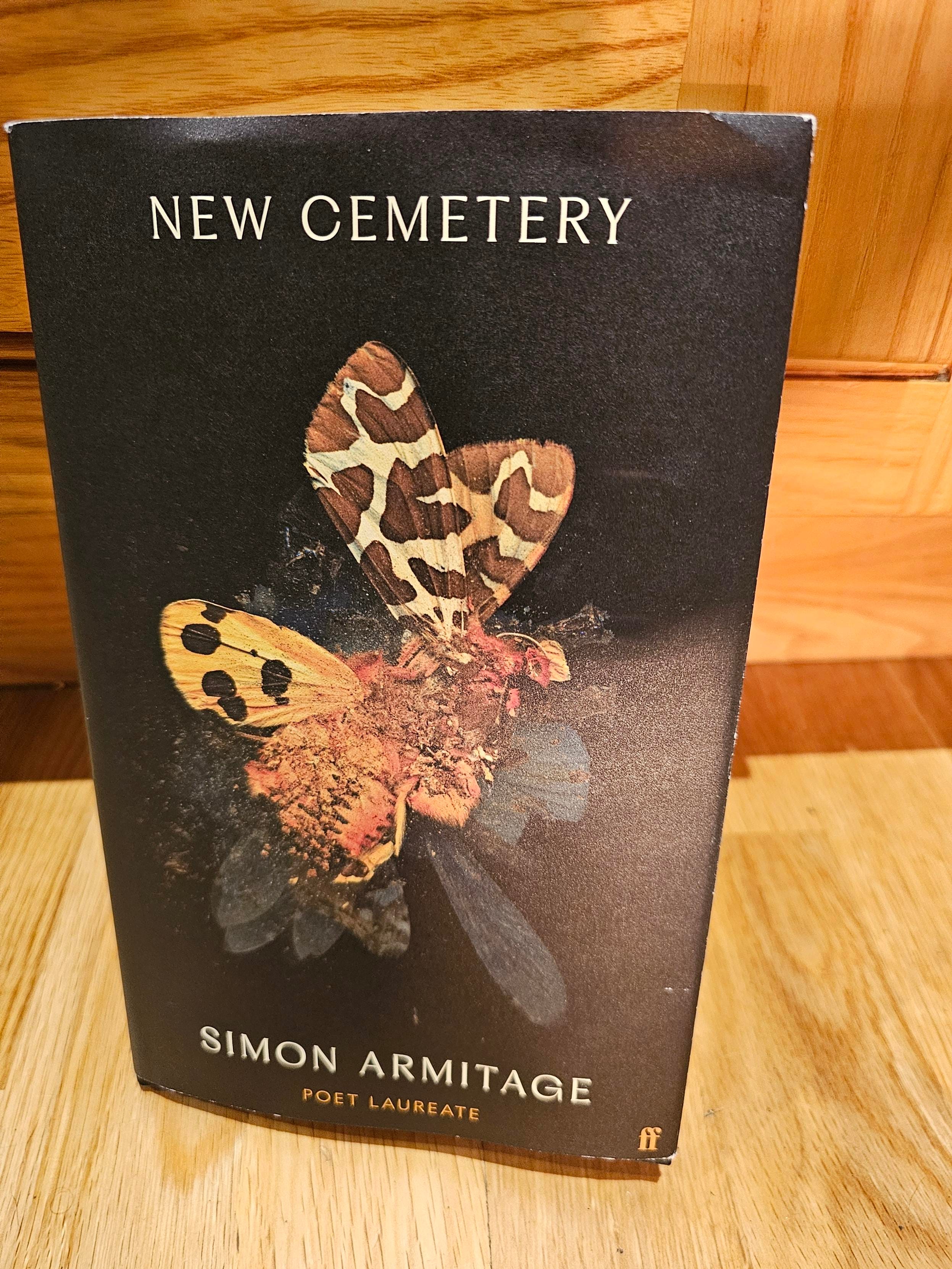
New Cemetery
Simon Armitage
Faber & Faber, 2025
I’m interviewing Simon Armitage very soon for Lancaster Litfest so I was very happy to be sent New Cemetery in advance of this event. I’ve always liked Simon Armitage’s work - and this book is no different. In fact, it’s made me want to go back and re-read some of the older collections as well, and reminded me how much I loved Seeing Stars in particular.
New Cemetery has that openness towards the reader that I think is a trademark of Simon Armitage’s work. The poems are always reaching out a hand to include the reader. Many of them in this book are addressed ‘Dear reader’. This collection again made me green with poetical envy. I’ve been wanting for a while to immerse myself in a place and just write about one corner of the world but I can never sit still long enough to do so, and yet this is exactly what Simon Armitage has done, charting the transformation of a local beauty spot into a municipal graveyard.
Each poem bears the name of a moth, although as SA tells us in the introduction, the names of the moths are not titles but the dedicatees of the poems. Often it feels as if we are walking with the poet through the cemetery, the moths flitting past in the dark, or sitting with him in the shed as he writes and the moths tap at the window to get in.
Throughout the observations of the changing landscape, there are personal transformations and social ones too - covid lockdowns come and go, as well as the death of a father.
Every poem is so carefully observed, stuffed full of wonderful turns of phrase. In “Campion” we get
"The kitchen window
              distraught with steam -
                     my mother at the twin-tub
“Distraught with steam”. Isn’t that wonderful - and just shows the power of the right adjective. I also loved ‘Heath Rivulet’ which details the discovery of a wasps nest:
"The frantic adding machine
          of a wasps' nest
                      in the eaves,
it's fizzing pregnancy.
Throughout, the act of writing, and where inspiration or poetry comes from is at the forefront. In “Large Emerald” we get “An idea arrives / on a low-loader. The humourless driver / slides from the cab…”. Or in “Blossom Underwing” he writes “A cheap ballpoint / usually does the trick - / just enough drag and flow -”.
So there are poems of quiet observation, but there is also humour in here too. One of my favourite poems was ‘Burnished Brass’ which I remember reading in The New Yorker under the title “I Am Simon Armitage”. This poem consists entirely of anagrams of Simon Armitage’s name - ‘Burnished Brass’ I think is a brilliant title, and the poem finishes rather brilliantly to with ‘Against Memoir I am’.
It’s a brilliant collection, and has made me now get all the other collections I’ve got out and put those on my to-be-read pile which at the moment is threatening to take over a fourth shelf.
I think the event with Simon Armitage in Lancaster has sold out, but there is a waiting list which I think is always worth joining.
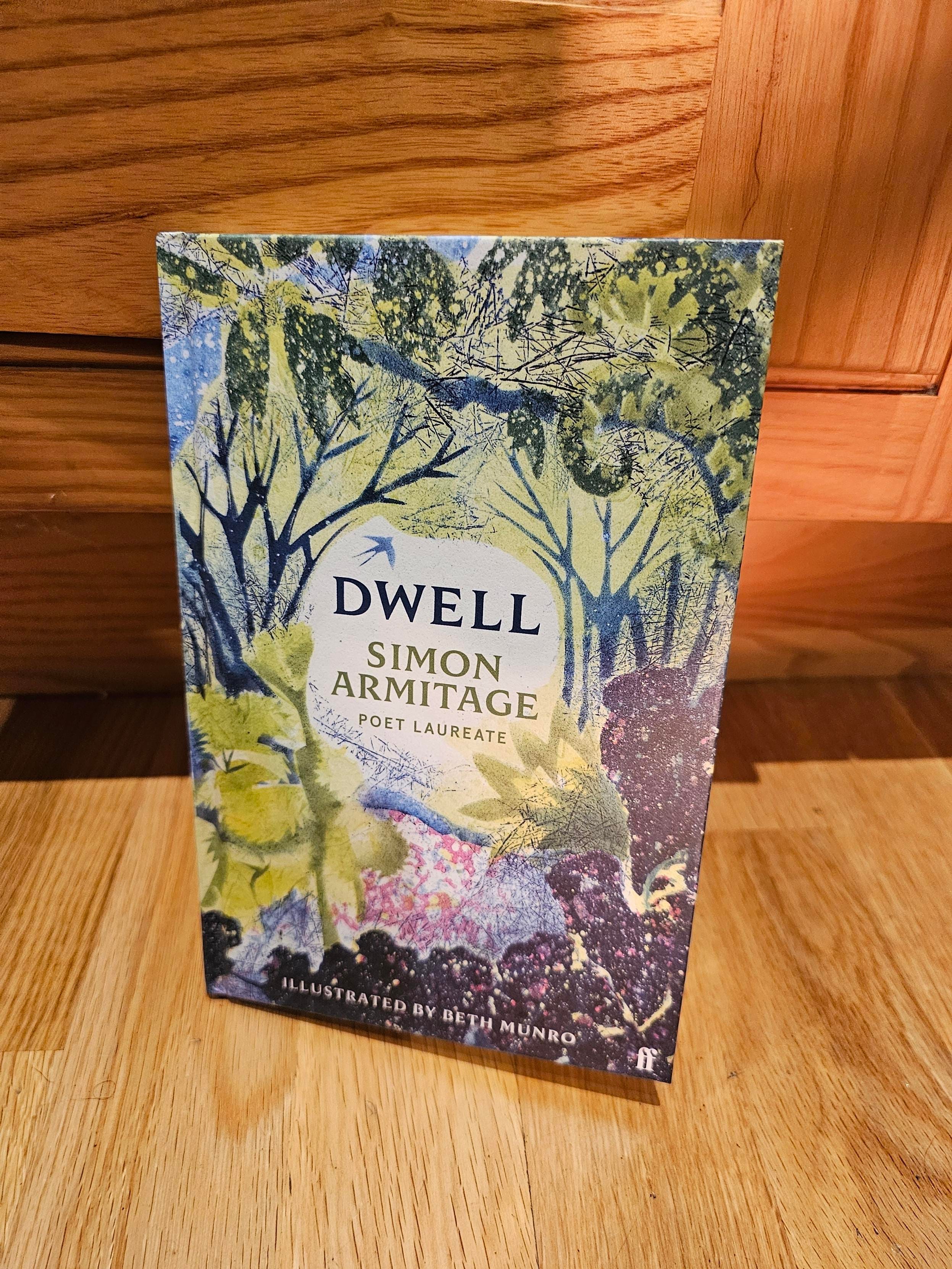
Dwell
Simon Armitage
Faber & Faber, 2025
I’ve been reading this book in preparation for the Lancaster event as well - this came out this year as well and is an absolutely stunning object in its own right. The introduction details how SA was invited to write a series of poems for the Lost Gardens of Heligan, Europe’s largest garden restoration project. The book concerns itself with the habitats that the creatures that we share the world with need to survive and thrive. All of the poems are named after a habitat - so we get “Pond” and “Drey” and “Hive” and “Web”.
I found these poems really moving. Here is the start of “Scrape”:
"They say every hare
is a broken heart
with legs, hatched
from the moon's egg".
Later there is a lovely description of the hair as ‘no more / than a poured puddle / of brown fur’.
The book contains beautiful illustrations by Beth Munro throughout which don’t really illustrate the poems but kind of sit alongside them in conversation with them. I’m really excited about the event in Lancaster - I have one more of Simon’s recent books to read: Blossomise and then I will be recapping back over some of the older collections so they may be included in November’s roundup!
If you would like to order any of the books above, you can order directly from the publishers through the links in the titles, or you can order from my Bookshop.org account
I bought New Cemetery today, the only one of your reads that Barrow Waterstones had in stock. Time to find my bus pass and see what Suttons has to offer in Ulverston. Anyhow, reading Blossom Underwing, I was very taken by "A cheap ballpoint/usually does the trick/just enough drag and flow"/. I immediately thought of Heaney's "Conway Stewart", now on sale for only £450! (the pen not the poem) It got me thinking. How do people write? My own favourite writing tools are a cheap fountain pen and a pencil. But I know one guy who writes everything on his phone.
Inspiring stuff, Kim. Thank you! Will look forward to hearing about the Lancaster event.