
Return to the Wild
- rewilding as a model for community, poetry and life - plus Wild Writing 2026

Kim I first launched this substack in 2024, perhaps as a way of avoiding the manuscripts we were both in the process of completing. Kim’s collection is now out in the world, and mine - I Saw What I Know - will be published in early 2027.
Since then, we’ve published 220 Substack articles. Rewilding Poetry was number 10. Here’s an updated version of it - I really hope you enjoy it!
Rewilding Poetry, by Clare
“will my wild things come back, will the horse
of my legs and the dragon of my ribs,
and the gentle sheep which lived in my throat
like a breath of mist and the silverfish
of my eyes and the skylarks of my hands
and the wolf of my heart, will they all come back
and live here again”
from “When I Open”, by Kim Moore
Like turmeric supplements and wild swimming, “Rewilding” is a concept you might have only recently encountered. But you’re likely to hear it a lot in the coming years, because it’s one of the most positive of contemporary responses to the climate and biodiversity crises.
“Rewilding” refers to “the large-scale restoration of nature until it can take care of itself – and us – again” (Rewilding Britain). It involves letting natural processes take control so that ecosystems can return to a self-sustaining state. I was the Resident Poet for the Carbon Landscape when I first saw it in action. On the raised bogs of Little Woolden and Caddishead, old drains were blocked, the land softened and dampened, the bogs regenerated. It felt like I was witnessing time rolling gently and dramatically backward.
Rewilding can take place at a smaller scale too – for example, letting long grass and weeds grow in your garden through No-Mow May, or cultivating plants which encourage bees. In all of its different scales and forms, rewilding is based in a faith in nature, in connectivity and community, balance, resilience, sustainability and hope; values which so many of us are craving in 2026.
Since I encountered it, I’ve had a strong sense that it has a great deal to teach us - not just about how we might live with nature, but with each other. And as a writer, I continue to believe that rewilding offers a model of how we might form sustainable communities of poetry; and how we might write poetry.
Robert Frost’s No surprise in the writer, no surprise in the reade” is crucial guidance but it’s not exactly news. The Romantics, Imagists, Surrealists, Beat Poets, Experimentalists … from William Wordsworth and Emily Dickinson to Kim Addonizio, Natalie Goldberg and of course, Mary Oliver, poets have sought themselves in the wild, and have tried to capture something of the wild in their poetry.
There’s a paradox at the heart of this. Poetry is possibly the most crafted form of writing; in which every element of language is used to deliberate effect – Dylan Thomas, it is said, could work for a full week on the placement of single full stop. Whether we obsess about punctuation or don’t use it at all, whether we write in form or free verse, the very fact of being a poet means that we work within pre-existing structures of language and thought. What can wild ever mean in this context?
It certainly does not mean untouched. There are very few true wildernesses left in the world, let alone the UK. The wild moors of the Brontēs were created by tree felling and sustained by sheep farming. Yet we all – like those sisters – have stood in wild places. Even the John Muir Trust – which protects the most iconic of wild places like the grand Canyon, Yosemite and Ben Nevis – recognises that wildness can be a much sdmaller, quiter or more urban experience - “Wildness is all around us. Wild nature survives even in our most densely populated cities”. Whilst the dictionary definition of wild is “uninhabited, uncultivated, or inhospitable”, in a thesaurus, its synonyms include: feral unbroken fierce unmanaged rugged rough desolate uninhabited stormy raging furious uncivilized savage fierce unrestrained uninhibited unconventional wayward unruly on fire delirious tumultuous passionate vehement eager infatuated foolish absurd unwise reckless fantastical (https://languages.oup.com/google-dictionary-en/)
I can still manage most of those in a good weekend, and - working within millennia of tradition - I hope my poetry can too. Imagery, for example, is an act of wildness. By presenting the reader with the sensory information they need to make their own sense, find their own meaning, we trust to uncertain and living forces, we set the poem free. In sound, we summon a living thing – which David Morley describes as “a spell that wakes you into a new world of possibility”. In form, in lay out, in structure. in the questions we ask, in the taboos that we break, in our use – or not – of punctuation, in juxtaposition, contradiction, in stating boldly and directly, in full rhyme and no rhyme, in telling our secrets, in speaking our bodies, in expressing most fully our desires, we can find wildness in this highly cultivated, heavily populated territory.
Wild is as wild does. Easy.
Except it’s not. Not least because it asks us to take a punt at the indefinable balance between form and formless, to find in the darkness the spark of light which flares up somewhere unmapped, somewhere between strict discipline and complete surrender. It’s what Ted Hughes is speaking about when he describes the poet as fisherman, seemingly doing nothing at all, but actually maintaining a relentless focus on unnamed possibilities. Or as Patricia Lockwood puts it in “Priestdaddy” .. “You start by thinking sideways … First you sit in a sunlit room, and you look at the wall but really look through it, and you read your book but really read past it .. Then pretend you’re washing your hair with warm water, and unfocus your vision like you’re trying to see a Magic Eye and loosen up your hearing like you’re trying to understand Donald Duck”.
Add to that the fact that poetry world is competitive, and individualistic. As a full-time writer, I sometimes work a 16-hour day, and still there are tasks not completed, and still there is no time to write poetry. I hardly ever have weekends off; I do most of my creative writing and editing on holiday, or late at night when I should be asleep. How do you let your words run wild if you’re earning less than the minimum wage, or if you have to get a first in your creative writing MA to justify the course fees and the time away from other priorities? How do you let go when you don’t understand the poem that everyone loves, or you have to write a poem-a-day, or what you most urgently want to say might lead to sweeping judgements in the poetry world, might even get you cancelled? When everyone is arguing, and you’ve been rejected again, and no-one will publish the book you’ve been working on for years, when you take your precious poem to a workshop and everyone finds something they want you to change, how then do you write freely and truly from your own heart?
And perhaps just as crucially, what can we do as a community, as readers, as friends and writers and peers, and teachers and mentors, competition judges, event organisers, publishers and editors, to support the wildness in each other? How can we shape the environment in which we create poetry, to encourage and sustain its wild heart?
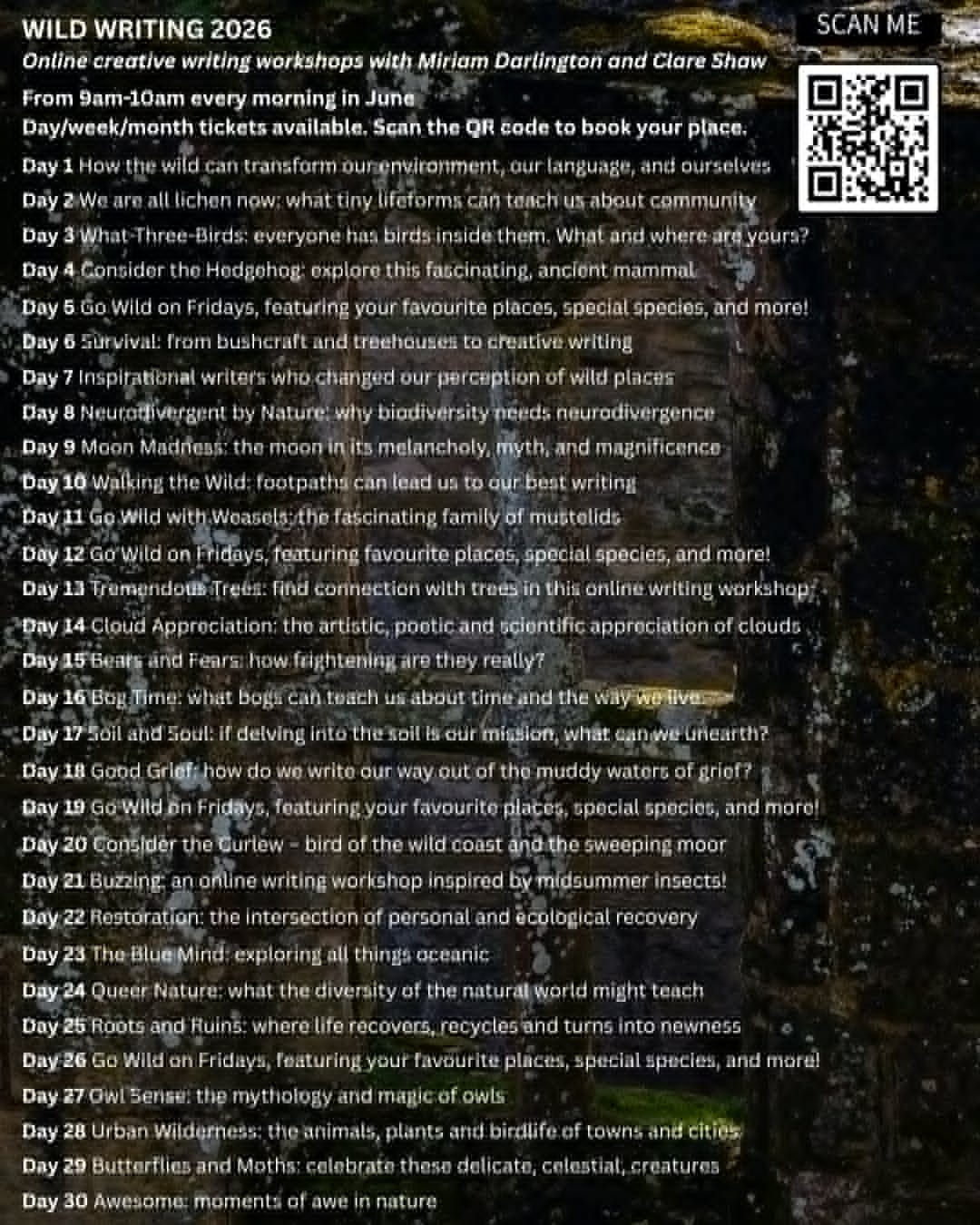
So many questions! Tomorrow, Miriam Darlington and I will begin to grapple with them as, in collaboration with the Writing School, we deliver the first of thirty themed daily online Wild Writing Workshops. Together with participants from across the globe, we’ll create wild poetry, memoir, stories and wild genre-defying writing on topics from clouds to queer nature to hedgehogs. All of the topics are listed below: you can buy tickets for a single day up to the whole month. Sessions take place from 9-10am and though they are not recorded - for copyright reasons - exercises and links will be shared on our unofficial facebook page for Wild Writing participants. Tomorrow’s theme is “Rewilding” - for more details on how to join Wild Writing, click here.
Can't wait! Last summer was so brilliant.
Can’t make the whole month 🙁 but have booked the final week. Can’t wait.