
A working-class chance
By Kim Moore

It’s been a few weeks since I’ve seen Clare Shaw in person - the longest we’ve gone without meeting up since I moved to Hebden Bridge two years ago! So I read with interest the last post which discussed the elephant in the room of working class writing.
I have been frustrated for a long time about how class is discussed in literary circles (if it ever comes up all). In the same way that domestic violence is only ever talked about when it results in a homicide, class seems to usually only be discussed in terms of extremes of poverty, so it was refreshing to read Clare’s post that leaned into the nuance and the hidden dynamics of class.
I also came from a family that thought teachers were ‘posh’. I remember holding my infant teacher’s hand as I walked round the playground, noticing how soft her skin was and then holding my mum’s hand when I got home from school, and then telling my mum about this. When I pointed out the difference between her hands and my teachers - I knew that she was angry, perhaps upset, and that there was something else beneath that - something closer to shame or resentment, which I didn’t understand at the time.
My mum left school at fifteen and after a brief stint working in a nightclub then worked in a shoe factory (Equity Shoes in Leicester if you’re interested!). My mum’s hands were hardened from the hours of work she did. She used to bring piecework home - what we called interlacing. My sister and I loved ‘helping’ her with it - I distinctly remember her looking over what we’d done and then having to redo it again. It hurt my fingers to do that work and I could only do it for a while.
I’ve never really written about my mum or the work she did, although I have written about my dad, particularly in my first collection. My dad was a scaffolder and came home every day covered in dirt and physically exhausted. One of my older sisters is a dinner lady, the other works in care homes. My brother in law is a plumber, my other brother in law is a builder. There is a vast difference between the hard physical labour that so many of my family do and have done their whole lives, and the labour that I do now - writing poems, teaching.
My mum and dad never talked about class to me when I was younger - and they only talk about it now when I bring it up. I told them I was writing this post, that I’m trying to talk about the nuances of class. My dad says that to him, working class is when you physically work for a job. That would mean, I say, that I was never working class then - but why then, do I feel working class when I go into certain spaces? But also, why do I feel as if I don’t belong when I go back home to my wider family? My brother-in-law has jokingly called me the ‘tax dodger’ since the age of eighteen when I went to university.
I remember once being told that I couldn’t be working class because I played in Leicester Schools Symphony Orchestra between the age of 16-18. But that discounts the nuance of class - that the only reason I learnt to play an instrument at all was because my mum and dad took me to a brass band and whilst doing my A-Levels, my trumpet teacher lent me his spare trumpet (held together with an elastic band!) so I could play in the orchestra. When I think of this now, it’s not the words that I remember but the scoffing of the person, the laughter when I tried to talk about the impact of class on my life. That I don’t speak with a Leicester accent because I tried to cover it up after the other brass players laughed at the way I spoke. The shame of that, of realising for the first time that not only did I have an accent but that it was the wrong accent. My A-Level teacher telling me off for not being able to attend an orchestral concert because I was working behind a bar. She said is that what you want to do for the rest of your life? She said this with such disdain, as if this was the worst thing in the world that could happen, not knowing that many people in my family worked jobs like this, that in fact I was glass collecting whilst my older sister worked behind the bar.
My mum and dad never took us to art galleries or readings, but they attended concerts because we (my sister and I) played in them. My mum only ever read magazines - Take a Break and Bella - but my dad loved reading. Our house was filled with books - my dad loved horror and fantasy fiction, and we all went to the library every Saturday morning. My mum and dad never went to any events at school held during the day because they were at work, but they never missed a parents evening, and drummed into us that education was important.
Every Thursday they got paid and they took us to the supermarket to get the weekly food shop, which had to last the whole week. We lived in a house with a mortgage, but every day we went to my nanna’s house after school. She lived on an estate, and told us that the kids who lived nearby wouldn’t like us because we weren’t from round there, and then gave us money to go to the shop for a loaf of bread. My sister and I used to run to the shop terrified that we would be beaten up, that they would be able to see from looking at us that we didn’t belong there.
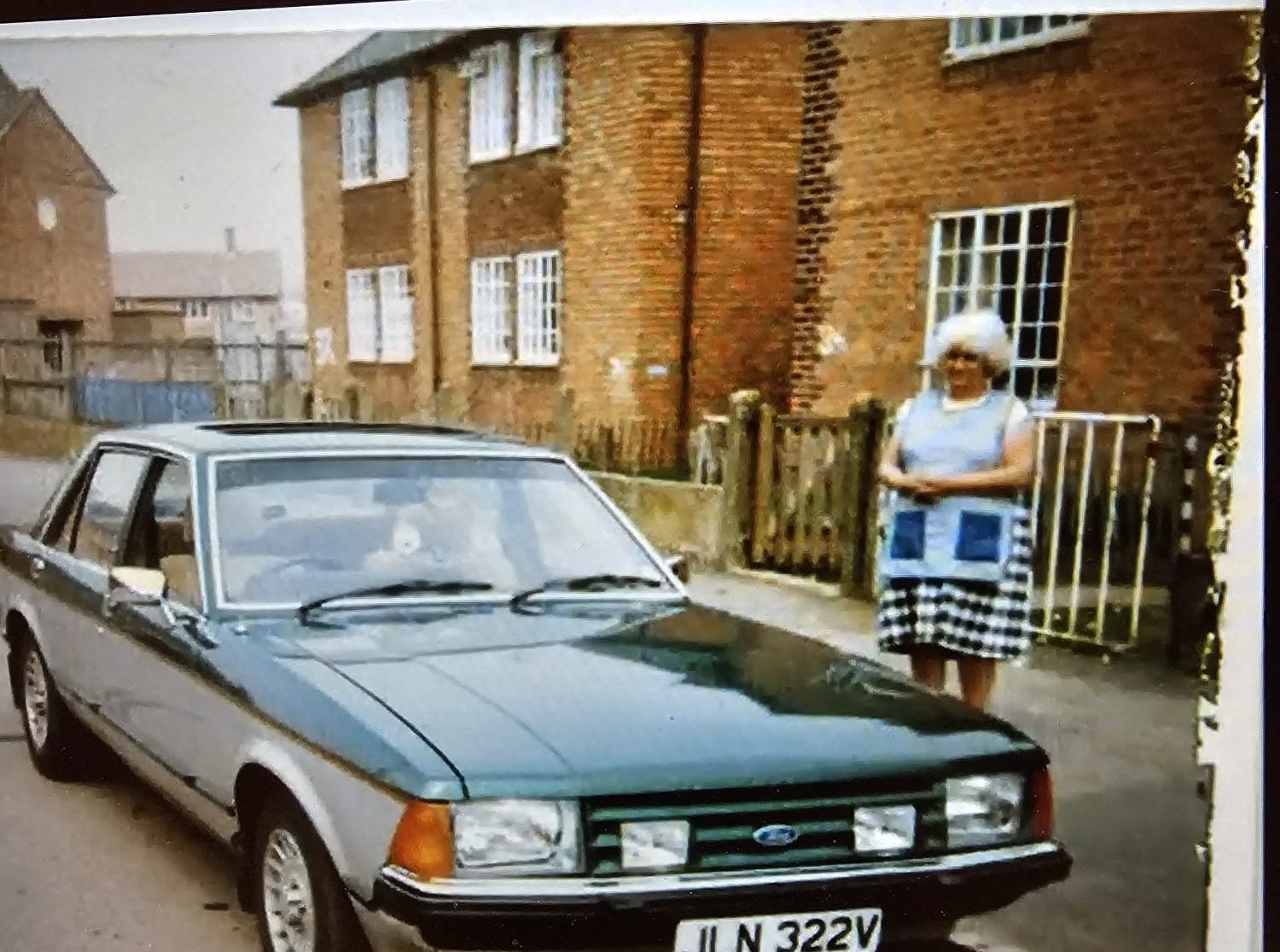
My mum and dad worked my whole life and had a car but nearly went bankrupt once, and money was a constant worry in our lives. But they paid for our swimming lessons and once a year (the July fortnight- the time all the working class went on holiday!) we went to Cornwall and stayed in a static caravan for a week. I loved our holidays for lots of reasons, but I realise now it was one of the few times that my mum and dad didn’t mention money, or say they couldn’t afford something. They saved up all year so they could go on holiday and eat out every night and not say ‘we can’t afford it’.
Before we went on holiday, they would take us shopping in C & A and we would be allowed to buy some holiday clothes and we would do a fashion show where we tried everything on, and then they would be packed up in a suitcase to take with us.
One day I saw an advert for a writing group in the library and I asked my parents if they would pay for me to go, and they said no, they couldn’t afford it.
Once my dad asked me what I wanted to be and I said I wanted to be a writer, and he said you can’t make a living out of writing, it should be something you do in your spare time. He said ‘what else do you want to be?’ and I said ‘a musician’ and then he just put his head in his hands in despair. Sometimes I wonder if I’ve spent my whole life trying to prove him wrong - having spent my life making a living from music and writing.
I want to write about class and talk about class, but there is a difference between the living conditions of my nanna, who lived in a council house on an estate her whole life, and my mum and dad who managed to buy a house and pay a mortgage and almost lose it and then escape losing it.
Yesterday when I told my mum and dad I was writing this post, they told me how uncomfortable they feel at readings. My dad said ‘I like listening to you, but it’s not my world’. It isn’t enough for me as their daughter to have access to those spaces - that isn’t enough to make them feel as if they belong. I felt really sad then, that I’d never thought about how they felt, being brought into this world of poetry readings and concerts (when I was a musician). How as a parent, you don’t know what kind of child you are going to get, and what places you have to follow them into.
If I was going by my dad’s definition of class, I would have no right to talk about it at all. He says I was brought up working class, that I have working class roots. I want to be able to be working class and be an academic or a writer or both, but I also know my lived experience now is worlds away from my family, worlds away from how I grew up, and how people living on those council estates are living. If achieving what we dreamt of makes us no longer working class, what do we turn into?
I had an interesting conversation with a poet who talked about a ‘working class sensibility’ at work in my poetry. This poet said of course we can be a working-class academic, that to discount that possibility basically means we can’t have ambition as a working-class person, that we have to stay in the box we are born into or written into by the people who get to tell the stories. Sometimes I worry that being in academia has driven that sensibility out of my writing. I have a poem called ‘Giving Birth with Anne Sexton’ in my next collection - but none of my family - my parents, my sisters, my cousins, my aunts and uncles - would know who she was unless I told them. They wouldn’t know what confessionalism was or how it has been used as a label predominantly against women. I have a poem called ‘The Kidnap’ about my mum and dad. I think the content of the poem shows our background without being specifically about it - but then at the end of the poem, I reference Persephone. Is this me turning the gaze of the poem to another audience, or is this just me trying to bring my mum and dad into this world that I live in again?
There is a brilliant essay over at The Bee - which talks about the complexities of describing class, and the use of the National Statistics Socio-economic Classification (NS-SEC). According to this definition, my dad was working class, coming in at level 6 as a scaffolder. My mum would have been at level 7 as a factory worker. This essay by Dave O’Brien talks about the difference between the technical measurement of class and our identity. I must confess, I only read this essay after thinking I’d finished mine - and then I got distracted and fell down The Bee rabbit hole, which is perfectly in character for the way I work.
But look at this statistic from the essay:
"In 2014, which was the first year class-origin data was available from the Office for National Statistics’ Labour Force Survey, almost half (47%) of all authors, writers and translators in the British workforce were from the most privileged social starting points (NS-SEC 1), contrasted to only 10% of those with parents from working-class origins (NS-SEC 6-8)".
I am officially one of the 10%. But by the NS-SEC as a Senior Lecturer at a university I’m not working-class anymore. Class is complex - it’s both fixed and changing. I guess what I would like to see is more nuanced representations of class in all this complexity - I will leave you with the final words from “Publishing’s Class Problem” by Dave O’Brien, talking about the impact of the lack of working-class people in publishing and in writing:
“It is about the impact of that on who is permitted to speak, who is allowed to take risks, and who is only offered a clichéd or inaccurate “gap in the market”. Finally, it is about the lived realities that are overlooked, assumed to be unimportant by commissioners, and never given a chance.”
Thanks for this, Kim. I feel a similar struggle, with my fire fighter Dad having "moved us away" to North Wales from Liverpool when we were kids to escape the city life he'd had. It made me strangely desperate to identify as scouse and working class, even as mum became a teacher and we achieved something like (through their physical and intellectual hard graft, I must add) middle class economic security. This "working class sensibility" is something I've clung to. I just get the ick thinking of myself as anything other, though I know the world I inhabit is so far from my working class roots. There feels almost an obligation to advocate for or represent that class, though in doing that, there's the danger of sentimentalising hardship or becoming the kind of snooty saviour my scouse family would hilariously take the piss out of. Christ, we were almost social pariahs for having moved out of childwall! Plenty to think anout. Really enjoyed reading. Gary
I've lived within this tension all my life. Grew up in a working-class family but encouraged became an academic. I changed who I was as far as my family were concerned. Had the experience you describe. Was I middle class then? Many children in post-war years were encouraged (and educated) to aspire. Those making judgements on writing, running literary journals, etc may have inheritance/are probably the next generation after the aspirers. Are my children middle class? Possibly. I always tell people of my background. I've worked in areas designed to open doors to others. Education, encouragement and confidence are key imo. These are political issues!
I write all the time about my life experience. I live by a code that supports the social contract that I benefitted from. Every year we lose elements of the contract means inequalities will become more stark.