
June Reading Diary
A month with Patricia Smith's music

The Intentions of Thunder: New and Selected Poems (Bloodaxe, 2026)
Patricia Smith
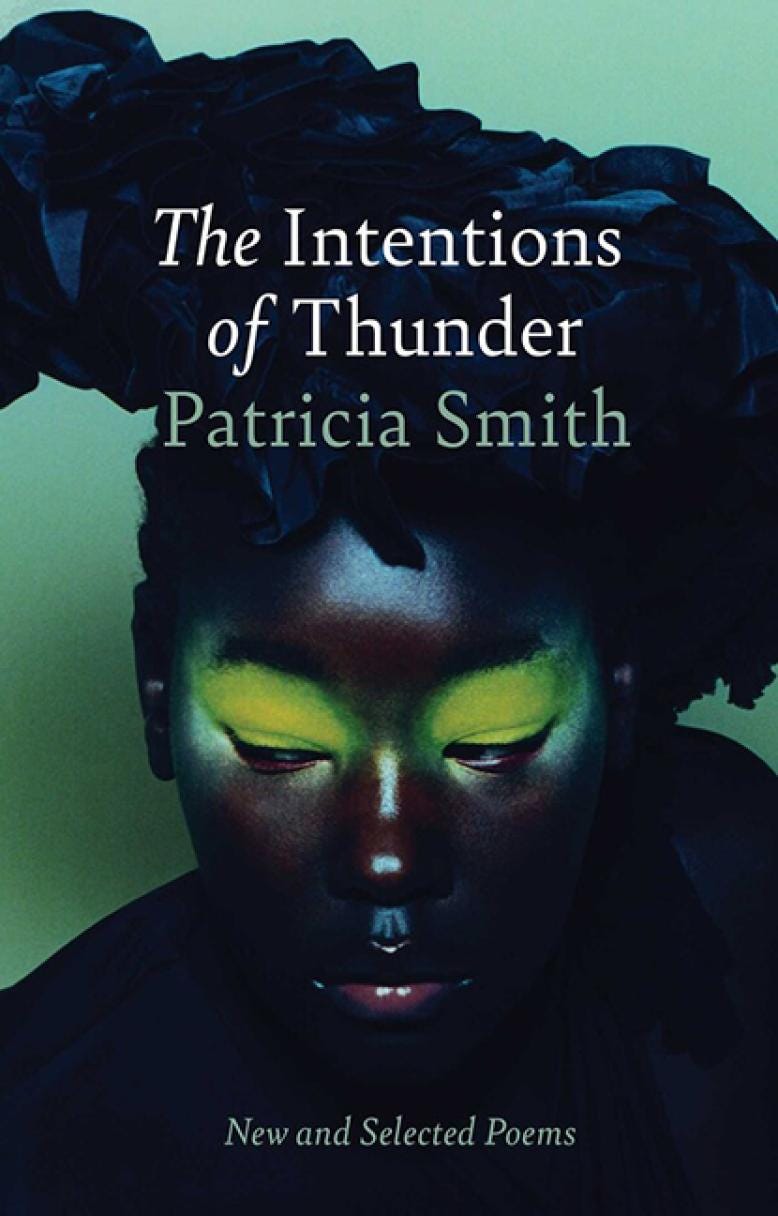
I’ve spent the month of June reading The Intentions of Thunder by Patricia Smith - an amazing poet who I was lucky enough to meet and hang out with at the Cork International Poetry Festival recently. This new and selected from Bloodaxe does a brilliant job of giving a sense of the range and development of Patricia’s work over the course of ten collections of poetry - enough to give you a real sense of the development of her poetics over the years, whilst leaving me wanting to buy each individual collection (not good for my bank balance!). The Intentions of Thunder also won the National Book Award for Poetry in 2025, which as far as I know is a rarity for a New and Selected. She has more accolades to her name than I can write here – you can read more about her and her work here…
I do think you need to read Patricia’s collections to get a real sense of the kind of poet she is, and preferably one after the other. I wish I’d found her work whilst I was researching for my PhD. There I was, trying to work out how to write about female desire and sexism and masculinity and whether poetry can create social change - and Patricia has been doing all that work (and more!) for decades, getting (as Danez Smith says on the back cover of The Intentions of Thunder) better and better with every book.
The Intentions of Thunder draws from many of her collections, starting with Life According to Motown, published in 1991 and finishing with Unshuttered, published in 2023. One of my favourite poems in the collection is the first poem “What It’s Like to Be a Black Girl (For Those of You Who Aren’t). It begins
first of all, it’s being 9 years old
and feeling like you’re not finished, like
your edges are wild, like there’s something –
everything - wrong.
Each book feels more like an album than a poetry collection – each one has its own identity, its own stage of development. Patricia has prefaced each book here with a short prose introduction which kind of tracks her development as a poet, her sense of her own poetics.
I loved the early collections for their sense of narrative and story that was always held in place by the music running through each poem. She doesn’t shy away from writing about trauma and violence, about masculinity but there is also such a wonderful sense of humour running through much of her work as well. The first poem of Big Towns, Big Talk, published in 1992 is “Annie Pearl Smith Discovers Moonlight” starts
My mother, the sage of Aliceville, Alabama,
didn’t believe that men had landed on the moon.
They can do anything with cameras
she hissed to anyone and everyone who’d listen,
even as moonrock crackled
beneath Neil Armstrong’s puffed boot.
In Close to Death, published in 1993, she begins to write more extensively about the intersections between masculinity and violence, about mothers and sons, about power and powerlessness. In ‘A Poem for the Man Who Shot My Father’ she writes ‘for the purposes of this poem / I will imagine you dead’. It is a strange dance that she performs in this poem – the poem has the power to imagine other endings, and yet it is ‘only’ an imagining. At the same time, the picture of the father’s face before he is shot, is both ‘only’ an imagining, and also is a picture that cannot be forgotten. It is a poem that asks what the power of imagining is, what the power of poetry is.
This also reminded me of the brilliant Terrance Hayes, and one of my favourite poems of his from American Sonnets for my Past and Future Assassin. The book is made entirely of sonnets, and one begins
I lock you in an American sonnet that is part prison,
Part panic closet, a little room in a house set aflame.
I lock you in a form that is part music box, part meat
Grinder to separate the song of the bird from the bone.
I still remember the first time I read those first four lines and I still carry them with me. Or maybe I am locked inside them and they are carrying me.
In the preface to Patricia Smith’s Close to Death, she writes that ‘Poems are really for people who don’t read them’ and this is picked up in ‘Building Nicole’s Mama’ in Teahouse for the Almighty (published in 2006). In the preface to this book she writes ‘The poet meets Nicole in a Florida that’s too much biting sun, but no sunshine. The little girl’s mother had just died of need and needles. Nicole is scrawny and wide-eyed and terrifying when she asks the poet to please undead her mother, okay? and make a poem do that. The poet takes a deep breath and lies about magic. But it’s not really lying, because –‘
Asking what poetry is for, and answering with poetry is what happens again and again throughout this book. In the preface to Blood Dazzler (published in 2008), which examines Hurricane Katrina and the devastation it caused, alongside the devastation caused by the inadequate response of the government, Patricia writes ‘Writers slip a medal over her head, say This is good work, poet. But when limelight washes over the snazzy awards, she sees a table of snarling skinheads, another table of immeasurably sad women without sons. Being poems still hasn’t saved them.’
This book is scorching in its anger and heartbreaking in its tenderness. There is a beautiful and moving sestina here which tells the story of Ethel Freeman, left waiting for help in her wheelchair outside the New Orleans Convention Center. As a poem it’s a masterclass in using the form to tell a story – here are the first two stanzas:
Ethel’s Sestina
Gon’ be obedient in this here chair,
gon’ bide my time, fanning against this sun.
I ask my boy, and all he says is Wait.
He wipes my brow with steam, says I should sleep.
I trust his every word. Herbert my son.
I believe him when he says help gon’ come.
Been so long since all those suffrin’ folks come
to this place. Now on the ground ‘round my chair,
they sweat in my shade, keep asking my son
could that be a bus they see. It’s the sun
foolin’ them, shining much too loud for sleep,
making us hear engines, wheels. Not yet. Wait.
How daring to use ‘son’ and ‘sun’ together in a sestina. I think a lesser writer might have used them both but on the same line, changing the spelling to give more possibility within the tightness of the form – but she goes for both and uses the energy and charge between them.
This is getting far too long already in terms of a substack post, but I wanted to give you an idea of the riches in the book! So I’m going to skip over some Uncollected poems and the 2012 Shoulda Been Jimi Savannah to go straight to Incendiary Art (published in 2017). This was the collection that quite rightly made her a finalist for the 2018 Pulitzer Prize, and the winner of the 2018 Kingsley Tufts Poetry Award and the 2017 Los Angeles Times Book Prize.
Throughout the book she writes about the deaths of black men and women at the hands of the police, beginning with a summary of the way they died in prose at the top of the poem. Many of these poems are in the voice of a mother. The poem for Kajieme Powell begins ‘I am the mother of that darkest magician’ and this idea of the victims of police brutality and murderous violence being magicians is one that returns again and again – the police claimed Kajieme Powell had a knife in his hands, despite video showing his hands were by his sides. As the poem says ‘He lunges for your neck while whistling on a side street / three blocks away’.
Three men - Victor White III, Jesus Huerta and Chavis Carter died in the back of a police cruiser and police claimed they shot themselves. The poem for them begins
He reached back and found
his own hands with his own
hands, worked his bound
fingers to set his free fingers
loose, then used that shackled
hand to free the other shackled
hand, and the freed shackled
hand, still shackled, was still
bound to the other hand once
both were freed.
This book was not an easy read – it is not called Incendiary Art for nothing – but in the way it centres the voice of mothers who have lost their children to police brutality and violence, the way it is both hyper-contemporary in its consideration of real life murders, but also timeless because of course, this type of police brutality continues – these things and more make it a truly radical collection.
The final collection is Unshuttered, published in 2023. This is an ekhphrastic collection, and the poems here take inspiration by or are haunted by photographs of 19th century Black Americans. The photographs are extraordinary and the voices Patricia creates, or channels are utterly convincing. There’s an interesting interview here with Patricia where she talks about writing this collection which is well worth checking out.
Finally the book finishes with uncollected poems, gathered between 2010 and 2024. ‘How to Find a Missing Black Woman’ is excoriating from the first line: ‘First, you’ll have to notice that she’s gone’. ‘Nap Unleashed’ is a deft and powerful crown of sonnets, taking black hair as its way of thinking through politics, racism, power and control. The third sonnet finishes ‘Our hair can’t be polite. / Once we were slaves. Our hair was furious.’
I can’t remember the last time I spent a month reading one poet - so thanks to Bloodaxe for making Patrica Smith’s work more easily available for UK readers. You can order the book direct from the Bloodaxe website here or from my bookshop.org account here.
Buy if: you are interested in the intersections between masculinity, race, female desire, violence, motherhood, sons, girlhood, and if you’re interested in a masterclass in how a poet can continue to develop and grow from collection to collection
Well, that's done it! You've ruined my bank balance no, Kim, even if yours is OK!!! I came to Patricia through Incendiary Art and was blown away by it, but I lost sight of her after that (so many brilliant poets, so many brilliant collections). Now, after reading this wonderful account of your experience of reading and the quotations you've offered, I'm gonna have to back to the beginning and start with that first collection. Then the second, third...
I’m reviewing this at the moment, such an incredible book